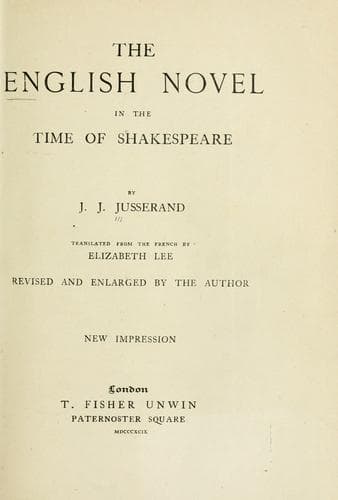
The English Novel in the Time of ShakespeareJusserand, J. J. (Jean Jules)
History
The English Novel in the Time of Shakespeare
Jusserand, J. J. (Jean Jules)
English fiction -- Early modern, 1500-1700 -- History and criticism
One of their chief pleasures was to tell their own stories. Of this
neither they nor their listeners were ever tired. Whenever in the course
of the tale a new person is introduced, the first thing he is expected
to do is to tell us who he is and what he has seen of the world.
Sometimes stories are included in his own, and when the first are
finished, instead of taking up again the thread of the main tale, we
merely resume the hearing of the speaker's own adventures: a custom
which sometimes proves very puzzling to the inattentive frivolous reader
of to-day. As for the supposed listeners in the tale itself, the men or
women the hero has secured for his audience, they well knew what to
expect, and took their precautions accordingly. We sometimes see them go
to bed in order to listen more comfortably. In "Cassandre," the eunuch
Tireus has a story to tell to Prince Oroontades: "The prince went to his
bedroom and put himself to bed; he then had Tireus called to him, and
having seats placed in the _ruelle_, he commanded us to sit," and then
the story begins; and it goes on for pages; and when it is finished we
observe that it was included in another story told by Araxe; wherefore,
instead of finding ourselves back among the actors of the principal
tale, we alight only among those in Araxe's narrative.[325] These
stories are thus enclosed in one another like Chinese boxes.
II.
This literature as soon as imported into England realized there the most
complete success. To find a parallel for it we must go back to the time
when mediaeval Lancelot and Tristan were sung of by French singers, and
afterwards by singers of all countries. Cyrus and Mandane, Oroontades
and Tireus, Grand Scipio and Illustrious Bassa, Astree and Celadon, our
heroes and our shepherds once more began the invasion and conquest of
the great northern island. As was to be expected from such unparalleled
conquerors, they accomplished this feat easily, and their work had
consequences in England for which France can scarcely offer any perfect
equivalent. Through their exertions there arose in this country a
dramatic literature in the heroical style which, thanks especially to
Dryden, has still a literary interest. But in France our heroes of
fiction were curtailed of much of their glory by the inexorable Boileau.
They left, it is true, some trace of their influence in the works of
Corneille and even of Racine, but the heroic drama, properly so called,
was restricted to the works of the Scuderys and Montchrestiens, which is
saying enough to imply that it was not meant to survive very long.
Public-domain text, read in full here on John Shaqi.
Reviews
Reviews
No reviews yet
Be the first to share your thoughts on this work.
Elsewhere in the archive
Join the Discussion
Join the discussion
Sign in to leave a comment or review.
Sign InorCreate an account