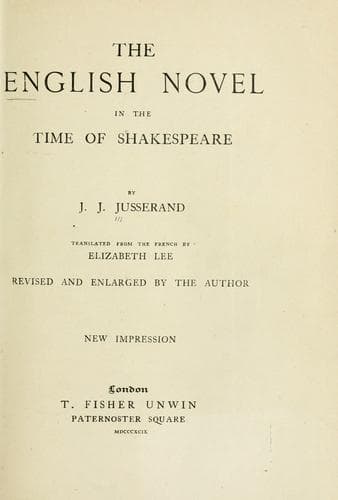
The English Novel in the Time of ShakespeareJusserand, J. J. (Jean Jules)
History
The English Novel in the Time of Shakespeare
Jusserand, J. J. (Jean Jules)
English fiction -- Early modern, 1500-1700 -- History and criticism
"Then sir, answered she, you must allow that whatever plays most exactly
answer this aforesaid end are most exact plays. Now I can instance you
many plays, as all those by Shakespeare and Johnson, and the most of Mr.
Dryden's which you criticks quarrel at as irregular, which nevertheless
still continue to please the audience and are a continual support to the
Theatre. There is very little of your unity of time in any of them, yet
they never fail to answer the proposed end very successfully....
Certainly, these rules are ill understood, or our nature has changed
since they were made, for we find they have no such effects now as they
had formerly. For instance, I am told the 'Double Dealer' and 'Plot and
no Plot' are two very exact plays, as you call them, yet all their unity
of time, place and action neither pleased the audience nor got the poets
money. A late play called 'Beauty in distress,'[362] in which the author
no doubt sweat as much in confining the whole play to one scene, as the
scene-drawers should, were it to be changed a hundred times, this play
had indeed a commendatory copy from Mr. Dryden, but I think he had
better have altered the scene and pleased the audience; in short, had
these plays been a little more exact as you call it, they had all been
exactly damn'd."
Further, some traits of character almost worthy of Fielding are to be
remarked in the course of the tale, though, it is true, it grows
confused towards the end, and touches the melodramatic in the same way
as Nash's novel. Thus the above conversation is interrupted by the
entrance of the coquette Emilia, long before loved by Peregrine who had
vainly asked for her hand. "Peregrine would have answered, but a pluck
by the sleeve obliged him to turn from Selinda to entertain a lady
mask'd who had given him the nudg. He presently knew her to be Emilia,
who whispered him in the ear: I find sir, what Guyomar said just now is
very true:
That love which first took root will first decay;
That of a fresher date will longer stay.
Peregrine tho surprised was pleased with her pretty reprimand, being
delivered without any anger, _but in murmuring, complaining accents,
which never fail to move_ ..."
Thus again, Peregrine goes to the famous St. Bartholomew fair, which was
still, as in Ben Jonson's time, a place of general meeting. "Lord C." is
there discovered, who had a masked lady with him; she pulls off her mask
and smiles at Peregrine, who again recognizes Emilia. The mixed
impressions that this sight makes on the hero are analysed in these
terms:
Public-domain text, read in full here on John Shaqi.
Reviews
Reviews
No reviews yet
Be the first to share your thoughts on this work.
Elsewhere in the archive
Join the Discussion
Join the discussion
Sign in to leave a comment or review.
Sign InorCreate an account