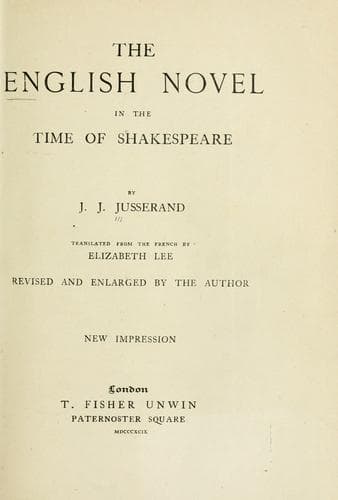
The English Novel in the Time of ShakespeareJusserand, J. J. (Jean Jules)
History
The English Novel in the Time of Shakespeare
Jusserand, J. J. (Jean Jules)
English fiction -- Early modern, 1500-1700 -- History and criticism
In writing of Shakespeare's contemporaries, care has been taken to enable
the reader to judge them on their own merits. With this view an effort has
been made to illustrate their spirit by what was best in their books, and
not necessarily what would recall the master-dramatist's works, and would
expose them to the extreme danger of being dwarfed by him beyond desert,
and of fading away in his light as moths in the sunshine. Considered from
this standpoint, they will not, however, cease to offer some degree of
interest to the Shakespearean student, for this process makes us aware not
merely of what materials Shakespeare happened to use, but from what stores
he chose them. On this account such works as Greene's tales of real life
have been studied at some length, and a chapter has been devoted to Nash,
who, high as he stands among the older novelists, has been allowed to pass
unnoticed as a tale writer by all historians of fiction. If, therefore, a
large use has been made of the publications of learned societies devoted
to the study of Shakespeare, liberal recourse also has been had to the
depositories of old original pamphlets, to the Bodleian library
especially, where, surprising as it may be in this age of reprints, single
copies of early novels, not to be met anywhere else, are even now to be
found. Some other writings of the same kind, even less known, such as
"Zelinda," a very witty parody of a romantic tale by Voiture, the
"Adventures of Covent Garden," illustrative of the novel and the drama in
the seventeenth century, were found in the primitive and only issue nearer
at hand, in that matchless granary of knowledge, whose name no student can
pronounce without a feeling of awe, because it is so noble, and of
gratitude, because it is so generously administered, the British Museum.
Engravings have been added, for it seemed that scattered as the rare
originals of our tales remain, it would be of assistance to gather
together those curious characteristics. They give an idea of the kind of
illustrations then in fashion, of the sort of appearance some of our
authors wore; they show how in the course of centuries, Guy of Warwick
was transformed from an armour-clad knight into a plain squire with a
cane and a cocked hat; and they exemplify the way in which foreign
artists were in several cases imitated with the burin, in the same books
in which foreign literary models were imitated with the pen. Objection
having been taken, in the very kindly criticisms passed upon this work,
to the absence of the only known representation of Greene, this defect
has been supplied in the present edition.
Public-domain text, read in full here on John Shaqi.
Reviews
Reviews
No reviews yet
Be the first to share your thoughts on this work.
Join the Discussion
Join the discussion
Sign in to leave a comment or review.
Sign InorCreate an account