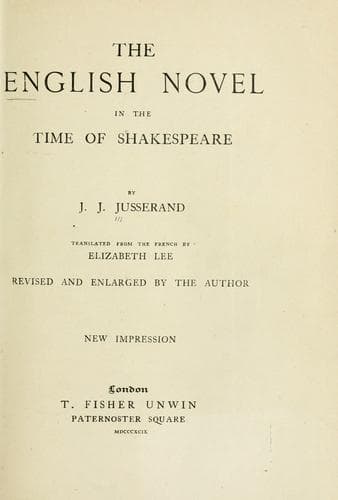
The English Novel in the Time of Shakespeare — John Shaqi
The English Novel in the Time of ShakespeareJusserand, J. J. (Jean Jules)
History
The English Novel in the Time of Shakespeare
Jusserand, J. J. (Jean Jules)
English fiction -- Early modern, 1500-1700 -- History and criticism
The means by which English printers supplied themselves with these
engravings, is a mystery that they have kept to themselves. Many of
the blocks were, very probably, purchased in the Low Countries. A very
few are almost certainly of English manufacture, and among them are
Caxton's illustrations of the Canterbury Tales: on this account we have
given a fac-simile of the most important of them, representing the
pilgrims seated round the table at the "Tabard" prior to starting on
their immortal journey. What is certain is that many of these wood-block
portraits of knights, supplied to the printers by English or Dutch
artists, underwent many successive christenings. The same knight, with
the same squire, the same dog and the same fabulous little wooden plants
between the legs of the horse was sometimes Romulus and sometimes Robert
of Normandy. In one book a rather fine engraving of a lord and a lady in
a garden, represents Guy of Warwick courting "fayre Phelis,"[28] but in
another book the same engraving does duty for "La bel Pucell" and the
knight "Graund Amoure."[29] It may be observed, in passing, that these
romances might be soundly criticized without much study of their
contents by simply inspecting their illustrations. Full as they are of
extraordinary inventions and adventures, unrestricted as their authors
were by considerations of what was possible or real, some dozen
well-chosen engravings seem enough to illustrate any number of them.
For, alas, there is nothing more stale and more subject to repetitions
than these series of extraordinary adventures; all their heroes are the
same hero, and whether he was following the philosophical turn of his
mind, or merely the thrifty orders of his printer, the engraver was well
justified in leaving as he did in most of his drawings an empty scroll
over the head of his knights, for the publisher to label them at will,
Robert the Devil or Romulus.
We are thus fairly advanced into the sixteenth century; the Renaissance
has come; before long Spenser will sing of the Fairy Queen and
Shakespeare will leave his native Stratford to present to a London
audience the loves of Juliet and Romeo. Scarcely any sign of improvement
appears yet in the art of novel-writing; nothing but mediaeval romances
continue to issue from the press; it is even difficult to foresee an
epoch in which something analogous to the actual novel might be produced
in England. Contrary to what was taking place in France at the same
time, that period seemed far off. In reality, however, it was near at
hand; the great age of English literature, the age of Elizabeth and of
Shakespeare, was about to furnish, at least in the rough draft, the
first specimens of the true novel.
[Illustration: LEO.]
FOOTNOTES:
Public-domain text, read in full here on John Shaqi.
Reviews
Reviews
No reviews yet
Be the first to share your thoughts on this work.
Join the Discussion
Join the discussion
Sign in to leave a comment or review.
Sign InorCreate an account