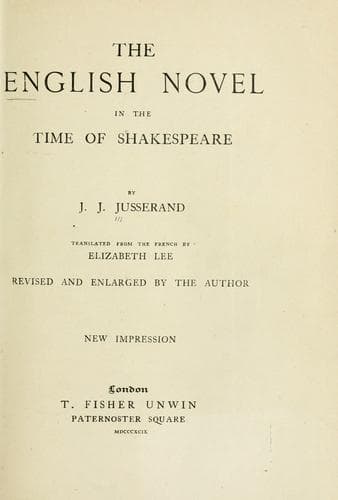
The English Novel in the Time of Shakespeare — John Shaqi
The English Novel in the Time of ShakespeareJusserand, J. J. (Jean Jules)
History
The English Novel in the Time of Shakespeare
Jusserand, J. J. (Jean Jules)
English fiction -- Early modern, 1500-1700 -- History and criticism
One of the most remarkable effects of the Renaissance was the awakening
of a slumbering curiosity. The _regime_ of the Middle Ages was just
ended; its springs were exhausted, its mysteries unveiled, its terrors
ridiculed. Armour was beginning to be thought troublesome; the towers of
the strong castles, dark and too much confined for the pleasures of
life; the reasonings of the schoolmen had grown old: blind faith was
out of fashion; a world was ending, and all that was sinking with it
appeared in the eyes of the young generation, out of season and "tedious
as a twice-told tale." The rupture between the Middle Ages and modern
times was complete in certain countries, partial in others, and
consequently the Renaissance had very different results among the
various peoples of Europe. But the same characteristic symptoms of an
eager, newly awakened curiosity manifested itself in all. There was no
longer question of continuing, but of comparing and of discovering. What
did the ancient Greeks and the old Romans say? What do our neighbours
think? What are their forms of style, their recent inventions? England
competed with France in her youthful curiosity, and English poets and
travellers following the example of their rivals beyond the seas,
"plundered" (in the words of Joachim du Bellay's famous manifesto[30]),
not only Athens and Rome, but Florence, Paris, Venice, and all the
enlightened towns of France, Italy, and Spain.
This curiosity spurred on the English in the different paths of human
knowledge and activity with an audacity worthy of the Scandinavian
Vikings. After having destroyed the Armada, they were going to burn the
Spanish fleet at Cadiz, to discover new lands in America and to give
them the name of "Virginia" in honour of their queen, and to attempt
the impossible task of discovering a way to China through the icy
regions of the North Pole. The fine gentlemen and the fine wits, even
the lack-dinner, lack-penny Bohemians of literature crossed the Channel,
the Alps, and the Pyrenees, seeking, they too, for gold mines to work,
gathering ideas, listening to stories, noting down recent discoveries,
and often appropriating the elegant vices and the light morals of the
southern nations. "An italianized Englishman is a devil incarnate" is a
popular proverb which quiet home-keeping men were never tired of
repeating.
Public-domain text, read in full here on John Shaqi.
Reviews
Reviews
No reviews yet
Be the first to share your thoughts on this work.
Join the Discussion
Join the discussion
Sign in to leave a comment or review.
Sign InorCreate an account