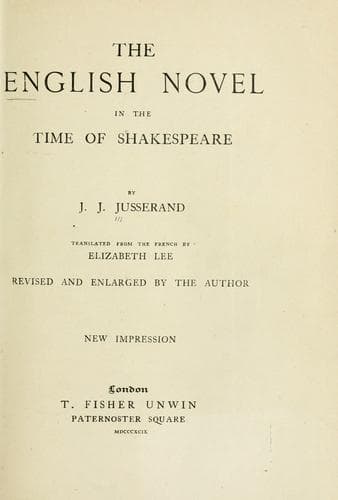
The English Novel in the Time of Shakespeare — John Shaqi
The English Novel in the Time of ShakespeareJusserand, J. J. (Jean Jules)
History
The English Novel in the Time of Shakespeare
Jusserand, J. J. (Jean Jules)
English fiction -- Early modern, 1500-1700 -- History and criticism
directions that you might finde out and reade them immediately. But I
beseech you ... to read them as my author ment them, to breed
detestation and not delectation," &c. And he then appends to his book a
table, by means of which the gentle readers will have no trouble in
finding the objectionable passages enumerated in the "Apologie" itself.
At the same time as translations proper, many imitations were published,
especially imitations of those shorter prose stories which were so
numerous on the continent, and which had never been properly
acclimatized in England during the Middle Ages. Their introduction into
this country had a great influence on the further development of the
novel; their success showed that there was a public for such literature;
hence the writing of original tales of this sort in English. Among
collections of foreign tales translated or imitated may be quoted
Paynter's "Palace of Pleasure," 1566,[42] containing histories from
Boccaccio, Bandello, Ser Giovanni Fiorentino, Straparole, the Spaniard
Guevara, the Queen of Navarre, "and other italian and french authours."
One of them is the history of "Rhomeo and Iulietta," from which
Shakespeare derived his immortal drama; another tale in the same
collection supplied the plot of "All's Well," and another the main
events of "Measure for Measure." Then came G. Fenton's "Tragicall
Discourses," 1567, finished at Paris and published by the author as the
first-fruits of his travels; T. Fortescue's "Foreste or collection of
histories ... done out of French," 1571; George Pettie's "Pettie Pallace
of Pettie his pleasure," 1576; Robert Smyth's "Straunge and tragicall
histories translated out of french," 1577; Barnabe Rich's "Farewell to
militarie profession," 1584, where Shakespeare found the plot of
"Twelfth Night"; G. Whetstone's "Heptameron of civill discourses," 1582;
Ed. Grimeston's translation of the "Admirable and memorable histories"
of Goulart, 1607, and several others.
Besides such collections many stories were separately translated and
widely circulated. A number have been lost, but some remain, such, for
instance, as "The adventures passed by Master F. I.," adapted by
Gascoigne from the Italian,[43] or a certain "Hystorie of Hamblet,"
1608,[44] which was destined to have great importance in English
literature, or the "Goodli history of the ... Ladye Lucres of Scene in
Tuskane and of her lover Eurialus," a translation from the Latin of
AEneas Sylvius Piccolomini, and one of the most popular novels of the
time. It went through twenty-three editions in the fifteenth century,
and was eight times translated, one of the French translations being
made "a la priere et requeste des dames." A German translation by
Nicolaus von Wyle is embellished with coloured woodcuts of the most
naive and amusing description. Three English translations were
published, one before 1550, another in 1669, and a third in 1741.[45]
Public-domain text, read in full here on John Shaqi.
Reviews
Reviews
No reviews yet
Be the first to share your thoughts on this work.
Join the Discussion
Join the discussion
Sign in to leave a comment or review.
Sign InorCreate an account