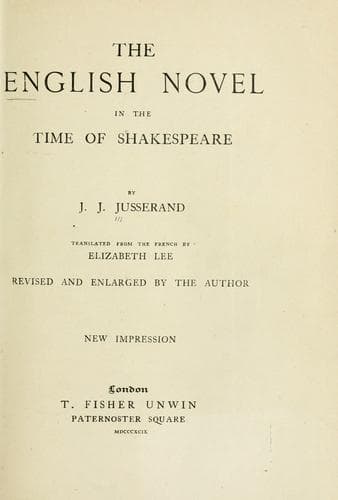
The English Novel in the Time of ShakespeareJusserand, J. J. (Jean Jules)
History
The English Novel in the Time of Shakespeare
Jusserand, J. J. (Jean Jules)
English fiction -- Early modern, 1500-1700 -- History and criticism
This part of the anathema, including as it does a description of the
superfluities of Elizabethan dress, is especially worth noticing: "Take
from them," cries Euphues, in a burst of eloquence, "their perywigges,
their paintings, their jewells, their rowles, their boulstrings, and
thou shalt soone perceive that a woman is the least part of hir selfe.
When they be once robbed of their robes, then wil they appeare so
odious, so ugly, so monstrous, that thou wilt rather think them serpents
then saints, and so like hags, that thou wilt feare rather to be
enchaunted than enamoured. Looke in their closettes, and there shalt
thou finde an appoticaryes shop of sweete confections, a surgions boxe
of sundry salves, a pedlers packe of newe fangles. Besides all this
their shadows, their spots, their lawnes, their leefekyes, their ruffes,
their rings, shew them rather cardinalls curtisans then modest
matrons.... If every one of these things severally be not of force to
move thee, yet all of them joyntly should mortifie thee." This was,
however, by no means the case, and Philautus not so much "cooled" by
this "carde" as his friend expected, behaved himself in such a way as to
demonstrate that, according to his experience, here was gross
exaggeration indeed.
Euphues shows better knowledge of the heart of woman when, continuing
his analysis of women's foibles, he comes to give his friend information
that teaches him in fact rather how to be loved than how to cease
loving: "Yet if thou be so weake being bewitched with their wiles that
thou hast neither will to eschue nor wit to avoyd their company ... yet
at the hearte dissemble thy griefe ... cary two faces in one hood, cover
thy flaming fancie with fained ashes ... let thy hewe be merry when thy
heart is melancholy, beare a pleasaunt countenaunce with a pined
conscience.... Love creepeth in by stealth, and by stealth slideth away.
If she breake promise with thee in the night, or absent hir selfe in the
day, seeme thou carelesse, and and then will she be carefull; if thou
languish [_i.e._, becomest slack in thy suit], then wil she be lavish of
hir honour, yea and of the other strange beast her honestie."
He continues in this bitter vein, avenging, as it seems, his private
wrongs, and vowing never, as far as he is himself concerned to have
anything more to do with women. From them, he is naturally led to think
of children who form an equally good theme on which to moralise. He does
not fail in this duty, and writes for the good of his friend, and of the
public at large, a little treatise very much in the style of some of
Pamela's letters,[87] where we are taught how "Ephoebus," the child that
is to be, should be brought up. Ephoebus is the Emile of this
sixteenth-century Rousseau. Always thorough and exact, Lyly is careful
to begin at the beginning, informing us at first "that the childe
shoulde be true borne and no bastarde."[88]
Public-domain text, read in full here on John Shaqi.
Reviews
Reviews
No reviews yet
Be the first to share your thoughts on this work.
Elsewhere in the archive
Join the Discussion
Join the discussion
Sign in to leave a comment or review.
Sign InorCreate an account