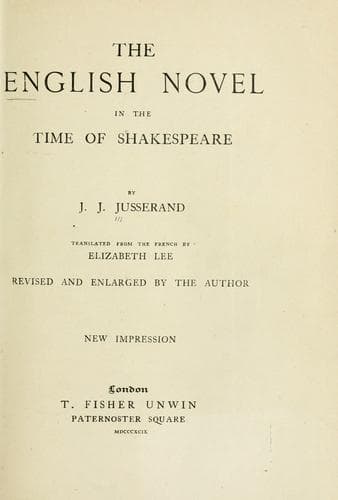
The English Novel in the Time of ShakespeareJusserand, J. J. (Jean Jules)
History
The English Novel in the Time of Shakespeare
Jusserand, J. J. (Jean Jules)
English fiction -- Early modern, 1500-1700 -- History and criticism
Then he comes to the bringing up of the boy, and with as much
earnestness as Jean-Jacques, and with true and moving eloquence, he
beseeches the mother to be the nurse of her own progeny. "It is most
necessary and most naturall in mine opinion, that the mother of the
childe be also the nurse, both for the entire love she beareth to the
babe, and the great desire she hath to have it well nourished: for is
there any one more meete to bring up the infant than she that bore it?
or will any be carefull for it, as she that bredde it?... Is the earth
called the mother of all things onely bicause it bringeth forth? No,
but bicause it nourisheth those things that springe out of it.
Whatsoever is bred in ye sea is fed in the sea; no plant, no tree, no
hearbe commeth out of the ground that is not moystened, and as it were
noursed of the moysture and mylke of the earth; the lyonesse nurseth hir
whelps, the raven cherisheth hir byrdes, the viper her broode, and shal
a woman cast away her babe?
"I accompt it cast away which in the swath clouts is cast aside, and
lyttle care can the mother have which can suffer such crueltie: and can
it be tearmed with any other title then cruelty, the infant yet looking
redde of the mother, the mother yet breathing through the torments of
hir travaile, the child crying for helpe which is said to move wilde
beastes, even in the selfe said moment it is borne, or the nexte minute,
to deliver to a straunge nurse, which perhappes is neither wholesome in
body, neither honest in manners, whiche esteemeth more thy argent though
a trifle, then thy tender infant, thy greatest treasure?" Here Lyly is
at his best, and neither Richardson nor Rousseau spoke better on this
point, which is one of their favourite subjects.
He goes on to show how his child should be brought up, with what
principles he should be imbued; many of these principles again very much
resembling those Rousseau was to accept and propagate two hundred years
later: "It is good nurture that leadeth to virtue, and discreete
demeanour that playneth the path to felicitie.... To be a noble man it
is most excellent, but that is our ancestors ... as for our nobilytie,
our stocke, our kindred, and whatsoever we ourselves have not done I
scarcely accompt ours.... It is vertue, yea vertue, gentlemen, that
maketh gentlemen.... These things [_i.e._, knowledge, reason, good
sense], neither the whirling wheele of Fortune can chaunge neither the
deceitful cavilling of worldlings separate, neither sickenesse abate,
neither age abolish." Then follows a dialogue between Euphues and an
atheist,[89] in which I need not say the latter is utterly routed; and
the book ends with a collection of letters[90] between Euphues and
various people who ask and get his advice on their difficulties,
oracle-wise, Pamela-wise too.
Public-domain text, read in full here on John Shaqi.
Reviews
Reviews
No reviews yet
Be the first to share your thoughts on this work.
Elsewhere in the archive
Join the Discussion
Join the discussion
Sign in to leave a comment or review.
Sign InorCreate an account