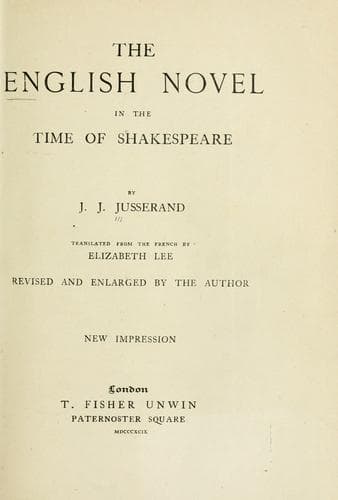
The English Novel in the Time of ShakespeareJusserand, J. J. (Jean Jules)
History
The English Novel in the Time of Shakespeare
Jusserand, J. J. (Jean Jules)
English fiction -- Early modern, 1500-1700 -- History and criticism
Many persons to whom the book doubtless recalled the memory of their
spring-time, shared Falstaff's ingenuousness, and remained faithful to
Lyly; if men or letters, after some years of enthusiasm, ceased to
imitate him, his book was for a long time continuously read, and it was
reprinted again and again even in the reign of Charles I. It was
translated into Dutch in the same century,[101] and was modernized in
the following, under the title: "The false friend and the inconstant
mistress: an instructive novel ... displaying the artifices of the
female sex in their amours."[102] High praise is rendered by the editor
to Lyly, who "was a great refiner of the English tongue in those days."
The book appeared not very long before Richardson's "Pamela," a fact
worthy of notice, the more so as in this abbreviation of Euphues, the
letters contained in the original have been reproduced and look the more
conspicuous in the little pamphlet. Quite Richardsonian, too, is the
table of contents which is rather a table of good precepts and useful
information, a very different table from the one appended by Harington
to his "Ariosto." Here we find enumerated the many wise recommendations
by which Lyly so long anticipated Richardson and Rousseau:
"The mother ought to be her own nurse p. 83.
"The wild beasts more tender of their young
than those who nurse not their own children p. 83.
"Children not to be frightened with stories
of spirits and bugbears (&c.) p. 86."
So much for the continuation of Lyly's fame. As for the period of
imitation proper, the era of euphuism's full glory, it lasted, as we
have said, hardly more than twelve or at most fifteen years. But it saw
the birth of works that are not without importance in the history of the
origin of the novel in this country.
[Illustration: LIBRA.]
[Illustration: KNIGHTLY PASTIMES. HAWKING, 1575.
_Illustrative of Gerismond's life in Lodge's "Rosalynd."_]
FOOTNOTES:
[67] "'Euphues' the anatomy of wyt ... wherin are contained the delights
that wyt followeth in his youth by the pleasauntnesse of Love, and the
happynesse he reapeth in age by the perfectnesse of wisedome"; London
[1579], 4to; reprinted by Arber, London, 1869. Lyly was born in 1553 or
1554; he died in 1606.
[68] Dedication of the second part: "To the Ladies and Gentlewoemen of
England." There is afterwards a sort of second preface addressed to the
"Gentlemen readers," but Lyly puts into it much less animation, and
appears to have written it only for conscience' sake in order not to
forget any one.
Public-domain text, read in full here on John Shaqi.
Reviews
Reviews
No reviews yet
Be the first to share your thoughts on this work.
Elsewhere in the archive
Join the Discussion
Join the discussion
Sign in to leave a comment or review.
Sign InorCreate an account