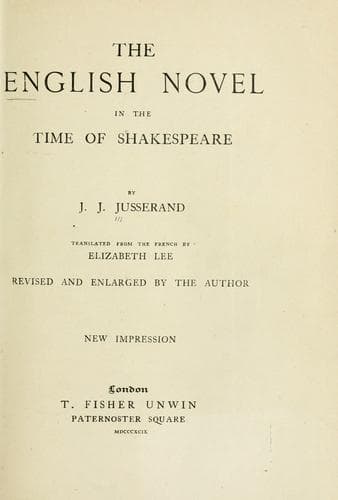
The English Novel in the Time of ShakespeareJusserand, J. J. (Jean Jules)
History
The English Novel in the Time of Shakespeare
Jusserand, J. J. (Jean Jules)
English fiction -- Early modern, 1500-1700 -- History and criticism
[69] In his excellent work, "Shakspere and Euphuism," _Transactions of
the New Shakspere Society_, 1884, Dr. Landmann was the first to break up
Lyly's style into its different parts, and point out the true sources
where he found not only the elements of his language, but even many of
his ideas. The same essay contains very useful information on Gongorism
and other kinds of affected styles of the sixteenth century. See also
Dr. Landmann's "Der Euphuismus," Giessen, 1881; his edition of part of
"Euphues," Heilbronn, 1887; and an article by Mr. S. L. Lee, _Athenaeum_,
July 14, 1883.
[70] The "Libro aureo" appeared in 1529; it was translated into French
in 1531, and went through a great many editions, entitled sometimes "Le
Livre dore de Marc-Aurele"; sometimes "L'Horloge des princes." North's
translation, which followed the French editions, is entitled, "The Diall
of Princes, by Guevara, englyshed out of the Frenche," London, 1557,
fol.; it had several editions. It is to the Marcus Aurelius of Guevara
that La Fontaine alludes in his "Paysan du Danube"; the story of the
peasant was one of the most popular of the "Golden Boke." Guevara's
style, with all the supplementary embellishments that Lyly has added,
was already to be seen in the collection of short stories by Pettie,
1576 (_supra_, p. 81) of which one of the early editions begins like
"Euphues," with an epistle to the "gentlewomen readers."
[71] "Le Bestiaire d'Amour," ed. Hippeau, Paris, 1840, 8vo. Richard de
Fournival died about 1260. The MS. followed in this edition is dated
1285.
[72] "Sa nature si est que quand il trouve un homme, si le devore, et
quand il l'a devore, si le pleure tous les jours de sa vie."
[73] Fragments of which remain in the "Codex Exoniensis," ed. Thorpe,
London, 1842, 8vo. The Panther, p. 355; the Whale, p. 360, &c.
[74] "An old English Miscellany, containing a bestiary," ed. R. Morris,
London, Early English Text Society, 1872.
[75] Recently published by Miss Lucy Toulmin Smith and M. Paul Meyer,
Paris, Societe des anciens textes Francais, 1889, 8vo.
[76] "The historie of Foure-footed beastes, describing the true and
lively figure of every beast," London, 1607, fol. "The historie of
Serpents or the second book of living creatures," London, 1608, fol.
[77] "Alcida. Greenes metamorphosis," licensed 1588; earliest known
edition, 1617.
[78] "Foure-footed beastes," _ut supra_, pp. 1, 199, 328, 453.
[79] "Historie of serpents," _ut supra_, pp. 111, 140, 236, &c.
[80] It should not, however, be thence concluded that Lyly is original
in all his moral dissertations; as Dr. Landmann has pointed out (see
_supra_, p. 106) he often borrows large passages from Plutarch and
Guevara; but what is remarkable is the intense and persistent
conviction, and also the success, at least success in so far that it was
read, with which this young man of twenty-five, who was of the world and
not of the church, preaches good morals to all classes of society.
Public-domain text, read in full here on John Shaqi.
Reviews
Reviews
No reviews yet
Be the first to share your thoughts on this work.
Elsewhere in the archive
Join the Discussion
Join the discussion
Sign in to leave a comment or review.
Sign InorCreate an account