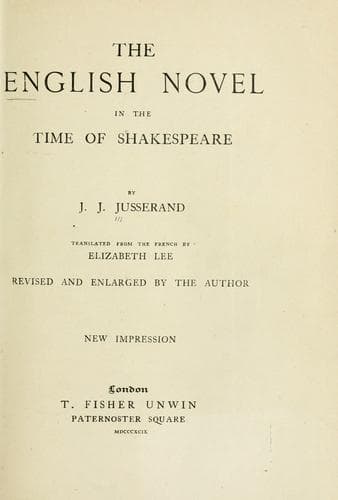
The English Novel in the Time of ShakespeareJusserand, J. J. (Jean Jules)
History
The English Novel in the Time of Shakespeare
Jusserand, J. J. (Jean Jules)
English fiction -- Early modern, 1500-1700 -- History and criticism
The reception awarded to "Mamillia" seems to have encouraged him to
continue writing. It had, in fact, crude as it seems to us now, many
qualities that would ensure it a welcome: its style was euphuistic; its
tone was Italian; its plot was intricate, and, lastly, there was very
much love in it. He continued therefore in this vein, writing with
extreme facility and rapidity improbable love stories, with wars, kings,
and princesses, with euphuism and mythology, with Danish, Greek,
Egyptian and Bohemian adventures. There was a "Myrrour of Modesty" which
has for its heroine the chaste Susannah, a "Gwydonius, the card of
fancie," again a tale in the Italian style, an "Arbasto" which tells of
the wars and loves of a Danish king, a "Morando," containing a series of
discussions and speeches on love, all of them entered or published in
1584-6. Then came his "Planetomachia," 1585, where the several planets
describe and exemplify their influence on human fate; "Penelopes web,"
1587, containing a succession of short stories; "Perimedes," 1588,
imitated from Boccaccio; "Pandosto," a tale of Bohemian and Sicilian
kings and shepherds, which had an immense success, much greater
according to appearances than the exquisite drama of a "Winter's Tale,"
that Shakespeare drew from it. "Alcida," a story of the metamorphosis of
three young love-stricken princesses of an island "under the pole
antartike," was apparently published in the same year; "Menaphon," a
charming pastoral tale, appeared in 1589, and several others followed.
His popularity was soon considerable; his books were in all the shops;
several went through an extraordinary number of editions; his name was
better known than any: "I became," says he, "an author of playes, and a
penner of love pamphlets, so that I soone grew famous in that qualitie,"
and who then "for that trade" was there "so ordinarie about London as
_Robin Greene_?"[113]
Public-domain text, read in full here on John Shaqi.
Reviews
Reviews
No reviews yet
Be the first to share your thoughts on this work.
Elsewhere in the archive
Join the Discussion
Join the discussion
Sign in to leave a comment or review.
Sign InorCreate an account