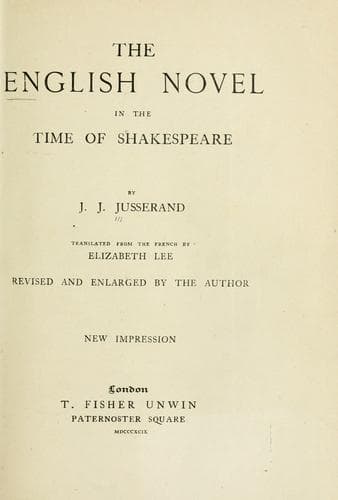
The English Novel in the Time of ShakespeareJusserand, J. J. (Jean Jules)
History
The English Novel in the Time of Shakespeare
Jusserand, J. J. (Jean Jules)
English fiction -- Early modern, 1500-1700 -- History and criticism
This savage abuse of young Shakespeare, who had probably mended at that
time more plays than we know, and more, surely, than he had personally
written, must not pass without the needful comment that his abuser was,
according to his own testimony, as ready, for a trifle, to make an
acquaintance and start a friendship as to turn a friend into a foe.
"Though," says he, "I knew how to get a friend, yet I had not the gift
or reason how to keepe a friend." He quarrelled, in fact, with most of
them, not excepting Nash and Marlowe, to whom he is now appealing
against Shakespeare; and his prefaces contain numerous attacks on the
writers of the time. It must be remembered, too, how bitter was the end
of poor Greene, how keenly he felt, he the boon companion _par
excellence_, finding himself "forsaken" in his need, and left alone in
the shoemaker's desolate room. It is curious to think that among the men
whose absence from his bedside he most resented was Shakespeare, and
that this want of a visit whetted his already ill-disposed mind into
expressing the only abuse known to have been directed by his
contemporaries against the author of "Hamlet."
Shakespeare, of course, did not answer;[121] his plea might have been
that if he did not pay much attention to others' authorship, much less
did he pay to his own; for he never published his own dramas, nor did he
protest when mangled versions of them were circulated by printers. He
only showed that Greene's criticisms had not much affected him by
turning later on another of the complainer's novels into a drama.
Shakespeare's friend, Ben Jonson, who was not accustomed to so much
reserve, speaks very disparagingly of Greene; he represents him as being
a perfectly forgotten author in 1599, which was untrue, and as for the
particular work in which Shakespeare was abused, he describes it as only
fit for the reading of crazy persons.
"_Trusty._ ... Every night they read themselves asleep on those books
[one of the two being the "Groats-worth"].
"_Epicoene._ Good faith it stands with good reason. I would I knew where
to procure those books.
"_Morose._ Oh!
"_Sir Amorous La Foole._ I can help you with one of them, mistress
Morose, the 'Groats-worth of wit.'
"_Epicoene._ But I shall disfurnish you, Sir Amorous, can you spare it?
"_La Foole._ O yes, for a week or so; I shall read it myself to him,"
&c.[122]
With the exception just mentioned, Greene's thoughts were all turned to
repentance. He had the consolation of receiving from his wife a kindly
message on the eve of his death, "whereat hee greatly rejoiced,
confessed that he had mightily wronged her, and wished that hee might
see her before he departed. Whereupon, feeling his time was but short,
hee tooke pen and inke and wrote her a letter to this effect:
Public-domain text, read in full here on John Shaqi.
Reviews
Reviews
No reviews yet
Be the first to share your thoughts on this work.
Elsewhere in the archive
Join the Discussion
Join the discussion
Sign in to leave a comment or review.
Sign InorCreate an account