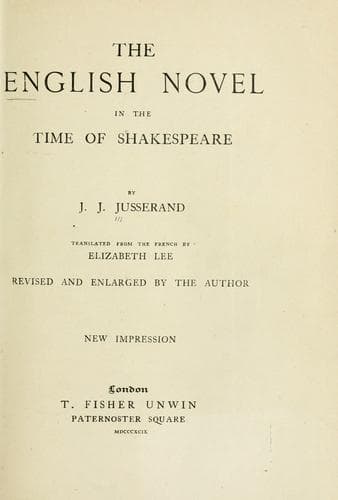
The English Novel in the Time of ShakespeareJusserand, J. J. (Jean Jules)
History
The English Novel in the Time of Shakespeare
Jusserand, J. J. (Jean Jules)
English fiction -- Early modern, 1500-1700 -- History and criticism
"Sweet wife, as ever there was any good will or friendship betweene thee
and mee, see this bearer (my host) satisfied of his debt: I owe him
tenne pound, and but for him I had perished in the streetes. Forget and
forgive my wronges done unto thee, and Almighty God have mercie on my
soule. Farewell till we meet in heaven, for on earth thou shalt never
see me more. This 2d of September, 1592. Written by thy dying
husband."[123]
He died a day after.
III.
Greene's non-dramatic works are the largest contribution left by any
Elizabethan writer to the novel literature of the day. They are of four
sorts: his novels proper or romantic love stories, which he called his
love pamphlets; his patriotic pamphlets; his conny-catching writings, in
which he depicts actual fact, and tells tales of real life forshadowing
in some degree Defoe's manner; lastly, his Repentances, of which some
idea has already been given.[124]
His love pamphlets, which filled the greatest part of his literary
career, connect him with the euphuistic cycle, and he is assuredly one
of Lyly's legatees. Possessing a much greater fertility of invention
than Lyly, he follows as closely as the original bent of his mind allows
him, the manner of his master. He is euphuistic in his style, wise in
his advice to his readers, and a great admirer of his own country.
His moral propensities do not lie concealed behind pretty descriptions
or adventures; they are stamped on the very first page of each of his
books and are expressly mentioned in their titles. In this too, like his
master Lyly, he may be considered a precursor of Richardson. He writes
his "Mamillia" to entreat gentlemen to beware how, "under the perfect
substaunce of pure love, [they] are oft inveigled with the shadowe of
lewde luste;" his "Myrrour of Modestie" to show "howe the Lorde
delivereth the innocent from all imminent perils and plagueth the
bloudthirstie hypocrites with deserved punishments." "Euphues his
censure to Philautus" teaches "the vertues necessary in every
gentleman;" "Pandosto" shows that "although by the meanes of sinister
fortune truth may be concealed, yet by Time in spight of fortune, it is
most manifestly revealed."[125] Quiet, wealthy, comfortable Richardson
had no better aim, and had, in fact, a very similar one, when he wrote
his "Pamela," as he is careful to state on the title-page, "in order to
cultivate the principles of virtue and religion in the minds of the
youth of both sexes;" and his "Clarissa," to show "the distresses that
may attend the misconduct both of parents and children in relation to
marriage." Be it said to the praise of both authors and readers, this
moral purpose so prominently stated did not in the least frighten the
public of ladies, whose suffrage, the two men, different as they were in
most things, were especially courting. Richardson's popularity among
them needs not to be recalled, and as for Greene, he was stated at the
Public-domain text, read in full here on John Shaqi.
Reviews
Reviews
No reviews yet
Be the first to share your thoughts on this work.
Elsewhere in the archive
Join the Discussion
Join the discussion
Sign in to leave a comment or review.
Sign InorCreate an account