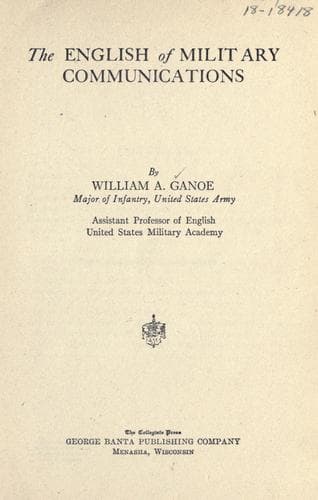
The English of military communicationsGanoe, William Addleman
History
The English of military communications
Ganoe, William Addleman
English language -- Rhetoric; Military orders; United States. Army -- Records and correspondence
(2) “I will try whenever I write to make myself unmistakable.”
(3) “I will try whenever I speak to make every word distinct from
every other word.”
(4) “I will try whenever I read to see how others express themselves
so that I may at the next opportunity imitate that part of their
style which says most in the simplest way.”
(5) “I will make every good new word my own, because the vocabulary
of my present life is limited.”
(6) “I will do all this because by so doing I shall develop myself in
my profession, and because I may some day fail that profession if I
neglect that development now.”
LECTURES
_Lectures_ are but extended _Explanations_. Officers are more and
more being called upon to appear before large audiences of educated
people in order to give to the country military knowledge. Training
Camps and war are increasing the necessity for the delivery of
lectures.
Because the _Lecture_ takes more time, it should be more carefully
developed than the _Explanation_. The subject should be divided into
its various parts in a logical way. It should be bound together
coherently. And each part should have in it only what belongs there.
This process is simply that of following the rules of English with
which we are already acquainted. The purpose is speed and clearness.
There are other elements which enter into the betterment of a long
talk. Since an audience is human, there is reason in helping it
through a dry subject. The treatment of the _Lecture_ may in this
way, besides aiding the interest, make the points stick longer.
Two qualities which help to attain this treatment are _Humor_ and
_Presence_.
Ordinarily the American does not need to be told to cultivate humor.
He reeks with it. But there are some instructors whose minds work
along so impassively that it is difficult for them to be wakened
from their gravity. To them the conscious development of the short
anecdote, homely illustration, and incongruous phrase is a splendid
aid. The great majority, however, must be guarded in the use of
humor. The quality itself may be overworked so that the proportion
of matter in the Lecture is small in comparison to the witticisms.
Humor is but a means to an end. Its sole object should be to lighten
the talk in order to help the subject into the auditor’s mind more
easily. Fun should be incidental and made without effort.
Public-domain text, read in full here on John Shaqi.
Reviews
Reviews
No reviews yet
Be the first to share your thoughts on this work.
Elsewhere in the archive
Join the Discussion
Join the discussion
Sign in to leave a comment or review.
Sign InorCreate an account