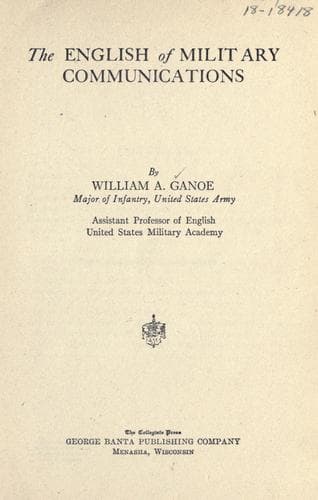
The English of military communicationsGanoe, William Addleman
History
The English of military communications
Ganoe, William Addleman
English language -- Rhetoric; Military orders; United States. Army -- Records and correspondence
Among the _Routine Reports_ in the military service should be
mentioned the _Morning_, _Inventory_ and _Inspection_, _Sick_, and
certain _Reports_ in official letter form.
The form of _Routine Report_ which is most common is the _Morning
Report_.
EXPLANATIONS
As we took up in each case after written work pertaining to combat
the similar verbal task, so now after we have discussed written
correspondence we are going to dwell upon the ordinary verbal labor
incumbent upon officers and non-commissioned officers in the military
service.
In war or peace a military leader is useless without an effective
tongue. We have demonstrated his uselessness in combat; we shall see
that he is just as unsatisfactory in training men for combat.
The work of any military individual in command of men is not only
that of _doing_ but also that of telling others _how_ to do. The
_Explanation_ of the efficient leader is a continuous process from
morning until night. He is constantly called upon to make his words
count. If he halts, he loses time. If he hesitates, he makes his men
restless. He must speak straight through to the end in a clear-cut
way, never hedging or repeating; and when he has finished, the
listeners should feel that the subject has been completely covered.
If he does not form the habit of so talking, he forfeits his power
of leadership. For what good is an intelligent or inventive officer,
if he cannot put his intelligence or invention out through his lips?
The military profession is one which depends upon quick instruction
by word of mouth. The officer who does his own work and the work of
his sergeants too, is plainly inefficient. He has avoided the harder
task—that of teaching others how to carry on the work. He has done
worse. He has lessened the value of his organization as an automatic
machine. When he leaves it, it will either fall to pieces or place a
weighty burden on the officer relieving him.[24]
There is one caution which a military man should observe in his
speech on the drill ground, in barracks, or in the field. He should
not repeat unnecessarily. He should not allow his men to gain the
idea that if they do not listen at once he will tell them later. It
should be an understood fact that his _Explanation_, once stated,
stands. Of course he may reiterate during his talk for the sake
of emphasis. But he should by practice be so capable of telling
everything so unmistakably the first time over that no reasonable
question can be asked.
Good explanations make for attention on the part of his men, and
attention makes for an increase of good work. Sooner or later the
achievements of his organization contrast it favorably with other
organizations and his brother officers say, “He has made a success.”
Much of that success has come to him because he has set for himself,
and followed these simple rules:
(1) “I will try today not to say anything which is not exactly
expressive of what I mean.”
Public-domain text, read in full here on John Shaqi.
Reviews
Reviews
No reviews yet
Be the first to share your thoughts on this work.
Elsewhere in the archive
Join the Discussion
Join the discussion
Sign in to leave a comment or review.
Sign InorCreate an account