The English of military communications — John Shaqi
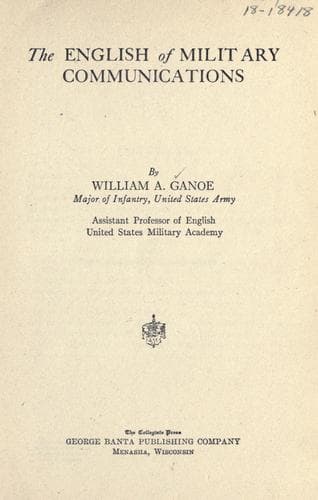
The English of military communicationsGanoe, William Addleman
History
The English of military communications
Ganoe, William Addleman
English language -- Rhetoric; Military orders; United States. Army -- Records and correspondence
It is important in military matters that a writer shall express
definitely the ideas he intends to convey and in such phraseology
that there can be no misunderstanding of the language used.
Carelessly or improperly phrased instructions have caused many
miscarriages of military plans. The attainment of perfection in the
use of language is a matter of painstaking study and the gradual
refinement of practice. Merely dreaming of what one will do when
responsibility is thrust upon him is not the way to prepare for
successful achievement. It is the duty of every self respecting
officer to be ready to do not only his best but to do what is right.
When one has qualified himself to write or dictate orders and
instructions properly he has already learned to interpret those he
may receive from others. Accuracy of language demands discipline
of mind. Under our system of raising war armies much has had to be
entrusted to men without either discipline of mind or of character.
This makes it necessary for officers not only to be qualified
themselves to prepare and to interpret orders, but to teach the art
to others.
Carelessly written instructions are like contoured maps with the base
data omitted, leaving one in doubt as to whether he is observing a
hill or a depression. A recent instance of such carelessness, coming
under my observation, may serve to illustrate this: orders were
received at my headquarters to call out certain reservists for actual
service and direct them to report at Fort Wayne, Indiana. In the
execution of the order individual telegrams were dispatched during
the night. As orders had been received previously to turn over for
the training of such reservists several permanent posts, including
Fort Wayne, near Detroit, Michigan, telegraphic inquiry was made
to find out if a mistake had been made. The reply established that
the Post of Fort Wayne, Michigan, and not the City of Fort Wayne,
Indiana, was intended.
Modern warfare of nations-in-arms is vastly different from the
campaigns and open field fighting of the smaller armies of past
wars. Nations no longer entrust the preparation and solution of
their military problems to old type of practical soldiers. Military
Academies, War Colleges, and General Staff Colleges have become
necessary to insure that only trained men shall be entrusted with the
preparation of instructions for the employment of the forces.
To combine the study of tactical problems, the preparation of orders
and the correct use of language, as contemplated by Major Ganoe, will
afford a great advantage to the student of today, and should make the
diaries, journals, and war histories of the future finished writings
without necessity for editing. These are the true sources of military
history, a knowledge of which is essential to the ambitious officer
desirous of perfecting himself in his profession.
Public-domain text, read in full here on John Shaqi.
Reviews
Reviews
No reviews yet
Be the first to share your thoughts on this work.
Join the Discussion
Join the discussion
Sign in to leave a comment or review.
Sign InorCreate an account