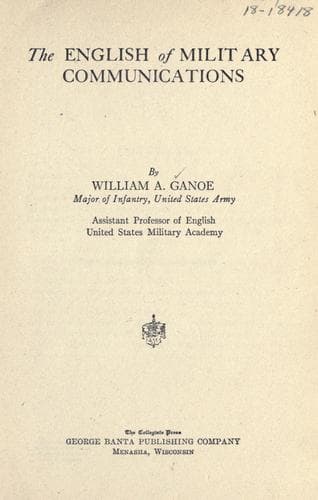
The English of military communications — John Shaqi
The English of military communicationsGanoe, William Addleman
History
The English of military communications
Ganoe, William Addleman
English language -- Rhetoric; Military orders; United States. Army -- Records and correspondence
5. On the 19th of February, 1940, a visiting patrol in charge of
Corporal Eaton sent out from 2d Battalion, which is acting as outpost
for the 81st Infantry, is on its way to a picket of friendly troops.
Its route lies from Boyd School House, E-8 toward McElheny. As it
approaches the bridge near the 4 in the 480 contour, it hears
footsteps of men hurrying into the timber to the east. The suspicions
of the patrol being aroused, it looks about and discovers loose earth
scattered over the snow at the abutments of the bridge; upon further
investigation it finds fuses leading from the center of the pile of
fresh earth. The message is finished on the spot at exactly midnight.
After the messenger has departed the corporal and one man remain on
guard over the mines whose fuses were cut before the messenger left.
6. You are Corporal Peters sent out with a visiting patrol from
Company A, 2d Battalion of your regiment. Your company is Support
number 2 of the outpost at the “K” in Oak Ridge, E-8. As you approach
Boyd School House, you are not challenged as you expect. You hurry
on to where the sentry of the picket should be posted at the
cross-roads, only to find him dead of a bayonet thrust. You go to the
south side of the school house and there find the remainder of the
picket in their blankets in the same condition. You put your hand
on one of the men and find that his body is still warm. At fifteen
minutes to three, September 30, 1932, you complete your message at
the spot where you found most of the picket dead. You then take your
remaining man with you and together perform double sentry duty at the
cross-roads.
7. On July 4, 1925, you are Sergeant Black in charge of an harassing
patrol sent out from the 68th regiment of Infantry which is acting as
outpost for the 12th Division. At a quarter to twelve at night, you
have just fired two volleys from Boyd School House in the direction
of Oak Ridge, and are proceeding toward C. Topper’s to do the same
there, when, as you cross the railroad one hundred yards south of the
“r” in Topper, you stumble upon a wagon wheel imbedded in the earth.
Cautious inspection reveals four howitzers camouflaged. With the aid
of known measurements upon your hand you find that the calibre of
each is 6 inches. You finish a message at a quarter to one and then
proceed as you intended.
Public-domain text, read in full here on John Shaqi.
Reviews
Reviews
No reviews yet
Be the first to share your thoughts on this work.
Join the Discussion
Join the discussion
Sign in to leave a comment or review.
Sign InorCreate an account