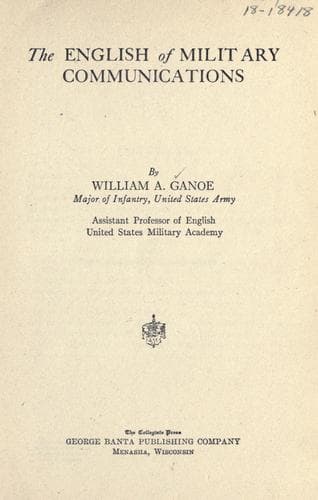
The English of military communicationsGanoe, William Addleman
History
The English of military communications
Ganoe, William Addleman
English language -- Rhetoric; Military orders; United States. Army -- Records and correspondence
10.—Major Quincy, in charge of the artillery battalion of the
preceding problem, assembles the captains of his batteries and issues
his instructions covered by the following data: he wishes Batteries
A and B to attack the hostile artillery, and he wishes them to take
up a position on the north end of the field near where the brigade
is halted. He wants Battery C to go to Hill 592. From that point
he wants that Battery to attack the hostile infantry. He gives to
his commanders the information which was contained in the aeroplane
message of the preceding problem. He also states that the enemy in
superior force is attacking from the west. He points out also that
between 3,000 and 4,000 yards to the southwest can be seen a long
line of artillery of the enemy and that this artillery is in action.
He also states that the first battalion of the first infantry, which
is now marching down the road, which is the support of the artillery,
will occupy Hill 592. Battery A’s target is to be the further half
of the line of the enemy’s guns, and Battery B’s target is to be the
nearer half. He states to his Battery Commanders that he has already
marked the position that they are to occupy with their commands,
and he tells them that they are to occupy this position at once and
prepare for immediate action. He tells Battery A that the adjutant
will give them the firing data and they are to range by volleys. They
are to report to him when ready, and they are to be on the alert and
await his order to commence firing. He also states that the advance
cavalry is on the Hill 651 south of Goldenville, and that they
are covering the right of the line. He wishes to tell his battery
commanders that the infantry is marching in a general direction
south, and that it is going from here to begin an attack against the
left of the enemy. He wishes to tell them also that he is to be,
during the action, on the left of Battery A.
CHAPTER X
THE OPERATION ORDER, ORDERS, LETTERS OF INSTRUCTION
Before August, 1914, the _Operation order_ was the English term for
our _Field order_. Both orders had the same functions and about the
same form. At times, the term _operation order_ was used by us to
include only battle orders, but on the whole, the terms _Operation
orders_ and _Field orders_ practically amounted to American and
English designations of the same thing.
Public-domain text, read in full here on John Shaqi.
Reviews
Reviews
No reviews yet
Be the first to share your thoughts on this work.
Elsewhere in the archive
Join the Discussion
Join the discussion
Sign in to leave a comment or review.
Sign InorCreate an account