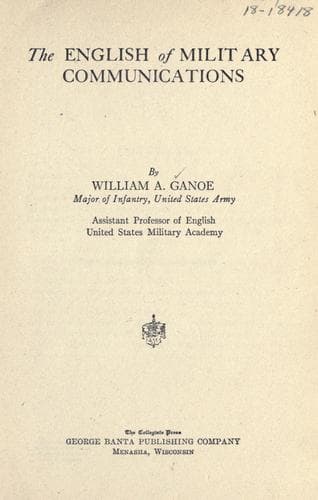
The English of military communicationsGanoe, William Addleman
History
The English of military communications
Ganoe, William Addleman
English language -- Rhetoric; Military orders; United States. Army -- Records and correspondence
In the beginning of the present war, after a few weeks of open
conflict, this kind of fighting in France gave way to a vast siege.
The English found themselves, after some cross-country fighting,
in the trenches. There the operation order which had provided for
situations of march, halt, bivouac, and battle, was gradually made
over to suit the peculiar needs of defenses, raids, and frontal
attacks. The barrage fire, bombs, mortars, machine guns, and
intricate lines of communication added to the number of details to
be considered. Little by little the will of the commander expressed
itself in such completeness that the former size of his operation
order passed all bounds. It was natural, then, that although the
scope and character of the English order steadily changed, its name
remained the same.
When the Americans came to take part in the war, the operation
order had during the previous years of struggle developed out of
all resemblance to its former self. It was no longer a field order
as we know the term. It was fully grown to meet the tremendous
progress of English experience in the trenches. The consequence was
that the American, finding both the state of siege and the order
to cover it beyond his experience, associated the English name with
the novel warfare. Thus, today, the operation order is a term used
in connection with the disposition of troops on the battle fronts of
Europe.
We should bear in mind, then, that the operation order is nothing
more than a field order fitted to trench conditions. We must not gain
the idea that it has supplanted the order which goes with mobile
exercises on open ground. Open warfare began this conflict, and will,
provided it be ended by martial victory, bring it to a close. Open
warfare has been the rule on the long Russian, Italian, Serbian,
Turkish, and Roumanian fronts. We must not be led astray in our
estimate of the proportions because the front in France and Belgium
is the most vital one to us from a strategic standpoint. Field
orders, which are the accompaniments of open warfare, should still
form the larger part of our study.
Nevertheless, the operation order is the order next in importance to
the field order. It must be framed with mathematical precision under
fire.
It has the greatest conciseness, but is not brief. It goes into
the minutest details, but its details are tersely put. In certain
parts it is telegraphic like the field message; in others it has
completed sentences like those of the field order. It has an orderly
arrangement of paragraphs and brief and unmistakable language. If
we are able to compose a good field message and order, we should
find, after we have familiarized ourselves with the technique of the
trenches, that the construction of the operation order will fall
naturally into place in our minds.
Public-domain text, read in full here on John Shaqi.
Reviews
Reviews
No reviews yet
Be the first to share your thoughts on this work.
Elsewhere in the archive
Join the Discussion
Join the discussion
Sign in to leave a comment or review.
Sign InorCreate an account