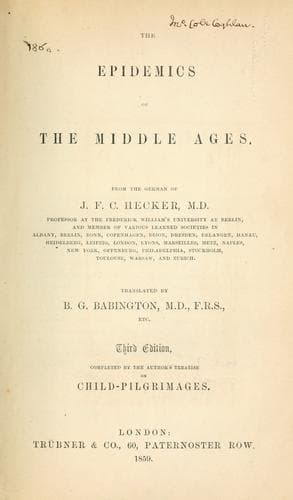
The Epidemics of the Middle AgesHecker, J. F. C. (Justus Friedrich Carl)
History
The Epidemics of the Middle Ages
Hecker, J. F. C. (Justus Friedrich Carl)
Black Death; Epidemics -- History; Hysteria, Epidemic
Where the disease was completely developed, the attack commenced
with epileptic convulsions[208]. Those affected fell to the ground
senseless, panting and labouring for breath. They foamed at the mouth,
and suddenly springing up began their dance amidst strange contortions.
Yet the malady doubtless made its appearance very variously, and was
modified by temporary or local circumstances, whereof non-medical
contemporaries but imperfectly noted the essential particulars,
accustomed as they were to confound their observation of natural events
with their notions of the world of spirits.
It was but a few months ere this demoniacal disease had spread from
Aix-la-Chapelle, where it appeared in July, over the neighbouring
Netherlands[209]. In Liege, Utrecht, Tongres, and many other towns of
Belgium, the dancers appeared with garlands in their hair, and their
waists girt with cloths, that they might, as soon as the paroxysm
was over, receive immediate relief on the attack of the tympany.
This bandage was, by the insertion of a stick, easily twisted tight:
many, however, obtained more relief from kicks and blows, which they
found numbers of persons ready to administer; for, wherever the
dancers appeared, the people assembled in crowds to gratify their
curiosity with the frightful spectacle. At length the increasing
number of the affected excited no less anxiety than the attention
that was paid to them. In towns and villages they took possession of
the religious houses, processions were everywhere instituted on their
account, and masses were said and hymns were sung, while the disease
itself, of the demoniacal origin of which no one entertained the
least doubt, excited everywhere astonishment and horror. In Liege the
priests had recourse to exorcisms, and endeavoured, by every means
in their power, to allay an evil which threatened so much danger to
themselves; for the possessed assembling in multitudes, frequently
poured forth imprecations against them, and menaced their destruction.
They intimidated the people also to such a degree that there was an
express ordinance issued that no one should make any but square-toed
shoes, because these fanatics had manifested a morbid dislike to
the pointed shoes which had come into fashion immediately after the
_Great Mortality_ in 1350[210]. They were still more irritated at
the sight of red colours, the influence of which on the disordered
nerves might lead us to imagine an extraordinary accordance between
this spasmodic malady and the condition of infuriated animals; but in
the St. John’s dancers this excitement was probably connected with
apparitions consequent upon their convulsions. There were likewise some
of them who were unable to endure the sight of persons weeping[211].
The clergy seemed to become daily more and more confirmed in their
belief that those who were affected were a kind of sectarians, and
on this account they hastened their exorcisms as much as possible,
Public-domain text, read in full here on John Shaqi.
Reviews
Reviews
No reviews yet
Be the first to share your thoughts on this work.
Elsewhere in the archive
Join the Discussion
Join the discussion
Sign in to leave a comment or review.
Sign InorCreate an account