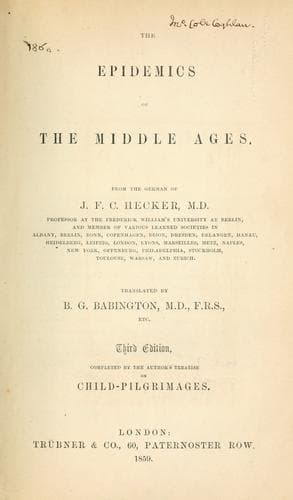
The Epidemics of the Middle AgesHecker, J. F. C. (Justus Friedrich Carl)
History
The Epidemics of the Middle Ages
Hecker, J. F. C. (Justus Friedrich Carl)
Black Death; Epidemics -- History; Hysteria, Epidemic
in order that the evil might not spread amongst the higher classes,
for hitherto scarcely any but the poor had been attacked, and the few
people of respectability among the laity and clergy who were to be
found among them, were persons whose natural frivolity was unable to
withstand the excitement of novelty, even though it proceeded from
a demoniacal influence. Some of the affected had indeed themselves
declared, when under the influence of priestly forms of exorcism,
that if the demons had been allowed only a few weeks more time, they
would have entered the bodies of the nobility and princes, and through
these have destroyed the clergy. Assertions of this sort, which those
possessed uttered whilst in a state which may be compared with that of
magnetic sleep, obtained general belief, and passed from mouth to mouth
with wonderful additions. The priesthood were, on this account, so much
the more zealous in their endeavours to anticipate every dangerous
excitement of the people, as if the existing order of things could have
been seriously threatened by such incoherent ravings. Their exertions
were effectual, for exorcism was a powerful remedy in the fourteenth
century; or it might perhaps be that this wild infatuation terminated
in consequence of the exhaustion which naturally ensued from it; at all
events, in the course of ten or eleven months the St. John’s dancers
were no longer to be found in any of the cities of Belgium. The evil,
however, was too deeply rooted to give way altogether to such feeble
attacks[212].
Public-domain text, read in full here on John Shaqi.
Reviews
Reviews
No reviews yet
Be the first to share your thoughts on this work.
Elsewhere in the archive
Join the Discussion
Join the discussion
Sign in to leave a comment or review.
Sign InorCreate an account