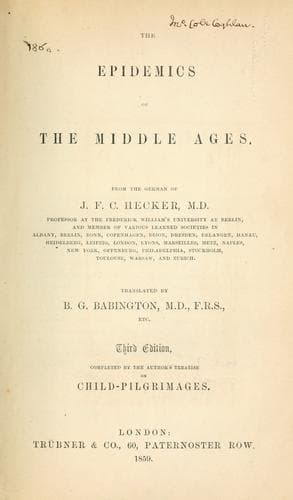
The Epidemics of the Middle AgesHecker, J. F. C. (Justus Friedrich Carl)
History
The Epidemics of the Middle Ages
Hecker, J. F. C. (Justus Friedrich Carl)
Black Death; Epidemics -- History; Hysteria, Epidemic
legend was invented at the beginning of the fifteenth century, or
perhaps even so early as the fourteenth, that St. Vitus had, just
before he bent his neck to the sword, prayed to God that he might
protect from the Dancing Mania all those who should solemnize the day
of his commemoration, and fast upon its eve, and that thereupon a voice
from heaven was heard, saying, “Vitus, thy prayer is accepted.”[220]
Thus St. Vitus became the patron saint of those afflicted with the
dancing plague, as St. Martin, of Tours, was at one time the succourer
of persons in small-pox; St. Antonius of those suffering under the
“hellish fire,” and as St. Margaret was the Juno Lucina of puerperal
women.
SECT. 3.—CAUSES.
The connexion which John the Baptist had with the dancing mania of
the fourteenth century, was of a totally different character. He
was originally far from being a protecting saint to those who were
attacked, or one who would be likely to give them relief from a malady
considered as the work of the devil. On the contrary, the manner in
which he was worshipped afforded an important and very evident cause
for its development. From the remotest period, perhaps even so far
back as the fourth century, St. John’s day was solemnized with all
sorts of strange and rude customs, of which the originally mystical
meaning was variously disfigured among different nations by superadded
relics of heathenism[221]. Thus the Germans transferred to the festival
of St. John’s day an ancient heathen usage, the kindling of the
“Nodfyr,” which was forbidden them by St. Boniface, and the belief
subsists even to the present day that people and animals that have
leaped through these flames, or their smoke, are protected for a whole
year from fevers and other diseases, as if by a kind of baptism by
fire[222]. Bacchanalian dances, which have originated in similar causes
among all the rude nations of the earth, and the wild extravagancies
of a heated imagination, were the constant accompaniments of this
half-heathen, half-christian, festival. At the period of which we are
treating, however, the Germans were not the only people who gave way
to the ebullitions of fanaticism in keeping the festival of St. John
the Baptist. Similar customs were also to be found among the nations
of Southern Europe and of Asia[223], and it is more than probable that
the Greeks transferred to the festival of John the Baptist, who is also
held in high esteem among the Mahomedans, a part of their Bacchanalian
mysteries, an absurdity of a kind which is but too frequently met with
in human affairs. How far a remembrance of the history of St. John’s
death may have had an influence on this occasion, we would leave
learned theologians to decide. It is only of importance here to add,
that in Abyssinia, a country entirely separated from Europe, where
Christianity has maintained itself in its primeval simplicity against
Public-domain text, read in full here on John Shaqi.
Reviews
Reviews
No reviews yet
Be the first to share your thoughts on this work.
Elsewhere in the archive
Join the Discussion
Join the discussion
Sign in to leave a comment or review.
Sign InorCreate an account