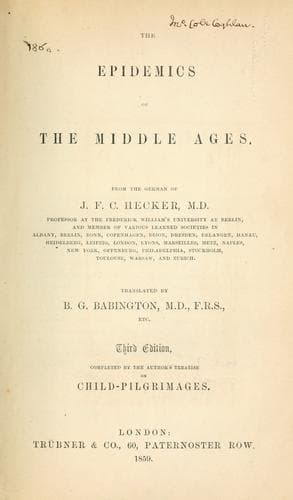
The Epidemics of the Middle AgesHecker, J. F. C. (Justus Friedrich Carl)
History
The Epidemics of the Middle Ages
Hecker, J. F. C. (Justus Friedrich Carl)
Black Death; Epidemics -- History; Hysteria, Epidemic
Mahomedanism, John is to this day worshipped, as protecting saint of
those who are attacked with the dancing malady[224]. In these fragments
of the dominion of mysticism and superstition, historical connexion is
not to be found.
When we observe, however, that the first dancers in Aix-la-Chapelle
appeared in July with St. John’s name in their mouths, the conjecture
is probable that the wild revels of St. John’s day, A. D. 1374, gave
rise to this mental plague, which thenceforth has visited so many
thousands with incurable aberration of mind, and disgusting distortions
of body.
This is rendered so much the more probable, because some months
previously the districts in the neighbourhood of the Rhine and the
Maine had met with great disasters. So early as February, both these
rivers had overflowed their banks to a great extent; the walls of the
town of Cologne, on the side next the Rhine, had fallen down, and a
great many villages had been reduced to the utmost distress[225].
To this was added the miserable condition of Western and Southern
Germany. Neither law nor edict could suppress the incessant feuds of
the Barons, and in Franconia especially, the ancient times of club
law appeared to be revived. Security of property there was none;
arbitrary will everywhere prevailed; corruption of morals and rude
power rarely met with even a feeble opposition; whence it arose that
the cruel, but lucrative, persecutions of the Jews, were in many
places still practised through the whole of this century, with their
wonted ferocity. Thus, throughout the western parts of Germany, and
especially in the districts bordering on the Rhine, there was a
wretched and oppressed populace; and if we take into consideration,
that among their numerous bands many wandered about, whose consciences
were tormented with the recollection of the crimes which they had
committed during the prevalence of the black plague, we shall
comprehend how their despair sought relief in the intoxication of an
artificial delirium[226]. There is hence good ground for supposing that
the frantic celebration of the festival of St. John, A. D. 1374, only
served to bring to a crisis, a malady which had been long impending;
and if we would further inquire how a hitherto harmless usage, which,
like many others, had but served to keep up superstition, could
degenerate into so serious a disease, we must take into account the
unusual excitement of men’s minds, and the consequences of wretchedness
and want. The bowels, which in many were debilitated by hunger and bad
food, were precisely the parts which in most cases were attacked with
excruciating pain, and the tympanitic state of the intestines, points
out to the intelligent physician, an origin of the disorder which is
well worth consideration.
SECT. 4.—MORE ANCIENT DANCING PLAGUES.
Public-domain text, read in full here on John Shaqi.
Reviews
Reviews
No reviews yet
Be the first to share your thoughts on this work.
Elsewhere in the archive
Join the Discussion
Join the discussion
Sign in to leave a comment or review.
Sign InorCreate an account