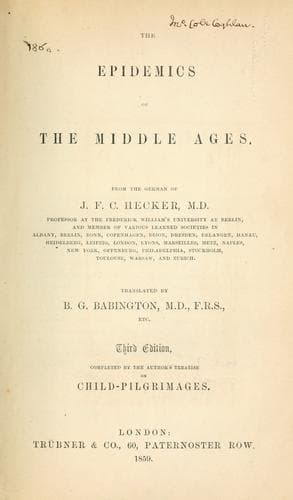
The Epidemics of the Middle AgesHecker, J. F. C. (Justus Friedrich Carl)
History
The Epidemics of the Middle Ages
Hecker, J. F. C. (Justus Friedrich Carl)
Black Death; Epidemics -- History; Hysteria, Epidemic
It was not until the beginning of the sixteenth century that the St.
Vitus’s dance was made the subject of medical research, and stripped
of its unhallowed character as a work of demons. This was effected by
Paracelsus, that mighty, but as yet scarcely comprehended reformer
of medicine, whose aim it was to withdraw diseases from the pale of
miraculous interpositions and saintly influences, and explain their
causes upon principles deduced from his knowledge of the human frame.
“We will not, however, admit that the saints have power to inflict
diseases, and that these ought to be named after them, although many
there are who, in their theology, lay great stress on this supposition,
ascribing them rather to God than to nature, which is but idle talk. We
dislike such nonsensical gossip as is not supported by symptoms, but
only by faith, a thing which is not human, whereon the gods themselves
set no value.”
Such were the words which Paracelsus addressed to his contemporaries,
who were as yet incapable of appreciating doctrines of this sort; for
the belief in enchantment still remained everywhere unshaken, and faith
in the world of spirits still held men’s minds in so close a bondage
that thousands were, according to their own conviction, given up as a
prey to the devil; while at the command of religion as well as of law,
countless piles were lighted, by the flames of which human society was
to be purified.
Paracelsus divides the St. Vitus’s dance into three kinds. First,
that which arises from imagination (Vitista, Chorea imaginativa,
æstimativa), by which the original dancing plague is to be understood.
Secondly, that which arises from sensual desires, depending on the will
(Chorea lasciva). Thirdly, that which arises from corporeal causes
(Chorea naturalis, coacta), which, according to a strange notion of
his own, he explained by maintaining, that in certain vessels which
are susceptible of an internal pruriency, and thence produce laughter,
the blood is set in commotion, in consequence of an alteration in the
vital spirits, whereby involuntary fits of intoxicating joy, and a
propensity to dance, are occasioned[234]. To this notion he was, no
doubt, led from having observed a milder form of St. Vitus’s dance, not
uncommon in his time, which was accompanied by involuntary laughter;
and which bore a resemblance to the hysterical laughter of the moderns,
except that it was characterized by more pleasurable sensations,
and by an extravagant propensity to dance. There was no howling,
screaming, and jumping, as in the severer form; neither was the
disposition to dance by any means insuperable. Patients thus affected,
although they had not a complete control over their understandings,
yet were sufficiently self-possessed, during the attack, to obey the
directions which they received. There were even some among them who
did not dance at all, but only felt an involuntary impulse to allay
Public-domain text, read in full here on John Shaqi.
Reviews
Reviews
No reviews yet
Be the first to share your thoughts on this work.
Elsewhere in the archive
Join the Discussion
Join the discussion
Sign in to leave a comment or review.
Sign InorCreate an account