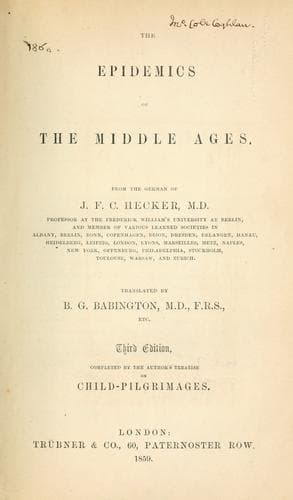
The Epidemics of the Middle AgesHecker, J. F. C. (Justus Friedrich Carl)
History
The Epidemics of the Middle Ages
Hecker, J. F. C. (Justus Friedrich Carl)
Black Death; Epidemics -- History; Hysteria, Epidemic
This disposition of mind, altogether so peculiar to the middle ages,
and which, happily for mankind, has yielded to an improved state of
civilization and the diffusion of popular instruction, accounts for
the origin and long duration of this extraordinary mental disorder.
The good sense of the people recoiled with horror and aversion from
this heavy plague, which, whenever malevolent persons wished to curse
their bitterest enemies and adversaries, was long after used as a
malediction[230]. The indignation also that was felt by the people
at large against the immorality of the age, was proved by their
ascribing this frightful affliction to the inefficacy of baptism by
unchaste priests, as if innocent children were doomed to atone, in
after years, for this desecration of the sacrament administered by
unholy hands[231]. We have already mentioned what perils the priests
in the Netherlands incurred from this belief. They now, indeed,
endeavoured to hasten their reconciliation with the irritated, and at
that time very degenerate people[232], by exorcisms, which, with some,
procured them greater respect than ever, because they thus visibly
restored thousands of those who were affected. In general, however,
there prevailed a want of confidence in their efficacy, and then the
sacred rites had as little power in arresting the progress of this
deeply rooted malady, as the prayers and holy services subsequently
had at the altars of the greatly revered martyr St. Vitus. We may
therefore ascribe it to accident merely, and to a certain aversion to
this demoniacal disease, which seemed to lie beyond the reach of human
skill, that we meet with but few and imperfect notices, of the St.
Vitus’s dance in the second half of the fifteenth century. The highly
coloured descriptions of the sixteenth century contradict the notion
that this mental plague had in any degree diminished in its severity,
and not a single fact is to be found which supports the opinion, that
any one of the essential symptoms of the disease, not even excepting
the tympany, had disappeared, or that the disorder itself had become
milder in its attacks. The physicians never, as it seems, throughout
the whole of the fifteenth century, undertook the treatment of the
dancing mania, which, according to the prevailing notions, appertained
exclusively to the servants of the church. Against demoniacal disorders
they had no remedies, and though some at first did promulgate the
opinion, that the malady had its origin in natural circumstances, such
as a hot temperament, and other causes named in the phraseology of the
schools[233], yet these opinions were the less examined, as it did not
appear worth while to divide with a jealous priesthood, the care of a
host of fanatical vagabonds and beggars.
SECT. 5.—PHYSICIANS.
Public-domain text, read in full here on John Shaqi.
Reviews
Reviews
No reviews yet
Be the first to share your thoughts on this work.
Elsewhere in the archive
Join the Discussion
Join the discussion
Sign in to leave a comment or review.
Sign InorCreate an account