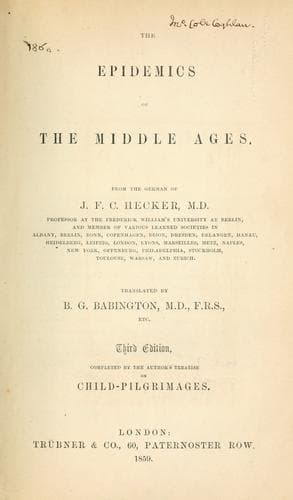
The Epidemics of the Middle AgesHecker, J. F. C. (Justus Friedrich Carl)
History
The Epidemics of the Middle Ages
Hecker, J. F. C. (Justus Friedrich Carl)
Black Death; Epidemics -- History; Hysteria, Epidemic
The learned Nicholas Perotti[247] gives the earliest account of this
strange disorder. Nobody had the least doubt that it was caused by
the bite of the _tarantula_[248][249], a ground-spider common in
Apulia; and the fear of this insect was so general, that its bite was
in all probability much oftener imagined, or the sting of some other
kind of insect mistaken for it, than actually received. The word
_tarantula_ is apparently the same as _terrantola_, a name given by
the Italians to the stellio of the old Romans, which was a kind of
lizard[250], said to be poisonous, and invested by credulity with such
extraordinary qualities, that, like the serpent of the Mosaic account
of the Creation, it personified, in the imaginations of the vulgar, the
notion of cunning, so that even the jurists designated a cunning fraud
by the appellation of a “stellionatus”[251]. Perotti expressly assures
us that this reptile was called by the Romans _tarantula_; and since
he himself, who was one of the most distinguished authors of his time,
strangely confounds spiders and lizards together, so that he considers
the Apulian tarantula, which he ranks among the class of spiders, to
have the same meaning as the kind of lizard, called ἀσκαλαβώτης[252],
it is the less extraordinary that the unlearned country people of
Apulia should confound the much dreaded ground-spider with the fabulous
star-lizard[253], and appropriate to the one the name of the other. The
derivation of the word tarantula, from the city of Tarentum, or the
river Thara, in Apulia[254], on the banks of which this insect is said
to have been most frequently found, or at least its bite to have had
the most venomous effect, seems not to be supported by authority. So
much for the name of this famous spider, which, unless we are greatly
mistaken, throws no light whatever upon the nature of the disease in
question. Naturalists who, possessing a knowledge of the past, should
not misapply their talents by employing them in establishing the dry
distinction of forms, would find here much that calls for research, and
their efforts would clear up many a perplexing obscurity.
Public-domain text, read in full here on John Shaqi.
Reviews
Reviews
No reviews yet
Be the first to share your thoughts on this work.
Elsewhere in the archive
Join the Discussion
Join the discussion
Sign in to leave a comment or review.
Sign InorCreate an account