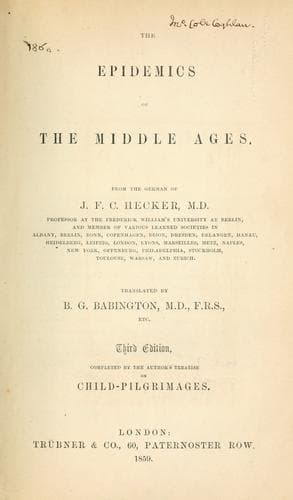
The Epidemics of the Middle AgesHecker, J. F. C. (Justus Friedrich Carl)
History
The Epidemics of the Middle Ages
Hecker, J. F. C. (Justus Friedrich Carl)
Black Death; Epidemics -- History; Hysteria, Epidemic
Perotti states that the tarantula, that is, the spider so called,
was not met with in Italy in former times, but that in his day it
had become common, especially in Apulia, as well as in some other
districts. He deserves, however, no great confidence as a naturalist,
notwithstanding his having delivered lectures in Bologna on medicine
and other sciences[255]. He at least has neglected to prove his
assertion, which is not borne out by any analogous phenomenon observed
in modern times with regard to the history of the spider species. It
is by no means to be admitted that the tarantula did not make its
appearance in Italy before the disease ascribed to its bite became
remarkable, even though tempests more violent than those unexampled
storms which arose at the time of the Black Death[256] in the middle
of the fourteenth century had set the insect world in motion; for the
spider is little, if at all, susceptible of those cosmical influences
which at times multiply locusts and other winged insects to a wonderful
extent, and compel them to migrate.
The symptoms which Perotti enumerates as consequent on the bite of the
tarantula agree very exactly with those described by later writers.
Those who were bitten, generally fell into a state of melancholy, and
appeared to be stupified, and scarcely in possession of their senses.
This condition was, in many cases, united with so great a sensibility
to music, that, at the very first tones of their favourite melodies,
they sprang up, shouting for joy, and danced on without intermission,
until they sank to the ground exhausted and almost lifeless. In others,
the disease did not take this cheerful turn. They wept constantly, and
as if pining away with some unsatisfied desire, spent their days in the
greatest misery and anxiety. Others, again, in morbid fits of love,
cast their longing looks on women, and instances of death are recorded,
which are said to have occurred under a paroxysm of either laughing or
weeping.
From this description, incomplete as it is, we may easily gather that
tarantism, the essential symptoms of which are mentioned in it, could
not have originated in the fifteenth century, to which Perotti’s
account refers; for that author speaks of it as a well known malady,
and states that the omission to notice it by older writers, was to be
ascribed solely to the want of education in Apulia, the only province
probably where the disease at that time prevailed. A nervous disorder
that had arrived at so high a degree of development, must have been
long in existence, and doubtless had required an elaborate preparation
by the concurrence of general causes.
Public-domain text, read in full here on John Shaqi.
Reviews
Reviews
No reviews yet
Be the first to share your thoughts on this work.
Elsewhere in the archive
Join the Discussion
Join the discussion
Sign in to leave a comment or review.
Sign InorCreate an account