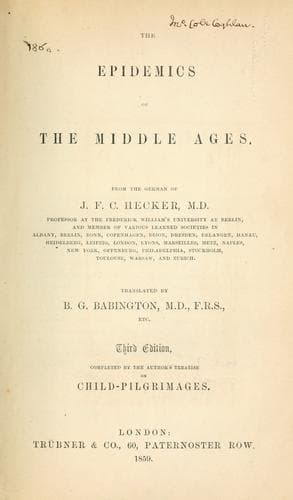
The Epidemics of the Middle AgesHecker, J. F. C. (Justus Friedrich Carl)
History
The Epidemics of the Middle Ages
Hecker, J. F. C. (Justus Friedrich Carl)
Black Death; Epidemics -- History; Hysteria, Epidemic
on circumstances which existed from the twelfth to the end of the
fourteenth century; for the origin of Tarantism itself is referrible,
with the utmost probability, to a period between the middle and the
end of this century, and is consequently contemporaneous with that of
the St. Vitus’s dance (1374). The influence of the Roman Catholic
religion, connected as this was, in the middle ages, with the pomp of
processions, with public exercises of penance, and with innumerable
practices which strongly excited the imaginations of its votaries,
certainly brought the mind to a very favourable state for the reception
of a nervous disorder. Accordingly, so long as the doctrines of
Christianity were blended with so much mysticism, these unhallowed
disorders prevailed to an important extent, and even in our own days
we find them propagated with the greatest facility where the existence
of superstition produces the same effect in more limited districts, as
it once did among whole nations. But this is not all. Every country in
Europe, and Italy perhaps more than any other, was visited during the
middle ages by frightful plagues, which followed each other in such
quick succession, that they gave the exhausted people scarcely any
time for recovery. The oriental bubo-plague ravaged Italy[261] sixteen
times between the years 1119 and 1340. Small-pox and measles were still
more destructive than in modern times, and recurred as frequently. St.
Anthony’s fire was the dread of town and country; and that disgusting
disease, the leprosy, which, in consequence of the crusades, spread
its insinuating poison in all directions, snatched from the paternal
hearth innumerable victims who, banished from human society, pined away
in lonely huts, whither they were accompanied only by the pity of the
benevolent and their own despair. All these calamities, of which the
moderns have scarcely retained any recollection, were heightened to
an incredible degree by the Black Death[262], which spread boundless
devastation and misery over Italy. Men’s minds were everywhere morbidly
sensitive; and as it happens with individuals whose senses, when they
are suffering under anxiety, become more irritable, so that trifles are
magnified into objects of great alarm, and slight shocks, which would
scarcely affect the spirits when in health, give rise in them to severe
diseases, so was it with this whole nation, at all times so alive to
emotions, and at that period so sorely pressed with the horrors of
death.
Public-domain text, read in full here on John Shaqi.
Reviews
Reviews
No reviews yet
Be the first to share your thoughts on this work.
Elsewhere in the archive
Join the Discussion
Join the discussion
Sign in to leave a comment or review.
Sign InorCreate an account