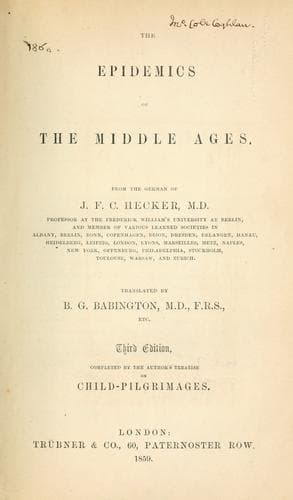
The Epidemics of the Middle AgesHecker, J. F. C. (Justus Friedrich Carl)
History
The Epidemics of the Middle Ages
Hecker, J. F. C. (Justus Friedrich Carl)
Black Death; Epidemics -- History; Hysteria, Epidemic
The bite of venomous spiders, or rather the unreasonable fear of its
consequences, excited at such a juncture, though it could not have
done so at an earlier period, a violent nervous disorder, which,
like St. Vitus’s dance in Germany, spread by sympathy, increasing
in severity as it took a wider range, and still further extending
its ravages from its long continuance. Thus, from the middle of the
fourteenth century, the furies of _the Dance_ brandished their scourge
over afflicted mortals; and music, for which the inhabitants of Italy,
now probably for the first time, manifested susceptibility and talent,
became capable of exciting ecstatic attacks in those affected, and then
furnished the magical means of exorcising their melancholy.
SECT. 3.—INCREASE.
At the close of the fifteenth century we find that Tarantism had
spread beyond the boundaries of Apulia, and that the fear of being
bitten by venomous spiders had increased. Nothing short of death
itself was expected from the wound which these insects inflicted, and
if those who were bitten escaped with their lives, they were said to
be seen pining away in a desponding state of lassitude. Many became
weak-sighted or hard of hearing, some lost the power of speech, and
all were insensible to ordinary causes of excitement. Nothing but
the flute or the cithern afforded them relief[263]. At the sound of
these instruments they awoke as it were by enchantment, opened their
eyes, and moving slowly at first, according to the measure of the
music, were, as the time quickened, gradually hurried on to the most
passionate dance. It was generally observable that country people,
who were rude, and ignorant of music, evinced on these occasions an
unusual degree of grace, as if they had been well practised in elegant
movements of the body; for it is a peculiarity in nervous disorders
of this kind, that the organs of motion are in an altered condition,
and are completely under the control of the over-strained spirits.
Cities and villages alike resounded throughout the summer season with
the notes of fifes, clarinets, and Turkish drums; and patients were
everywhere to be met with who looked to dancing as their only remedy.
Alexander ab Alexandro[264], who gives this account, saw a young man in
a remote village who was seized with a violent attack of Tarantism. He
listened with eagerness and a fixed stare to the sound of a drum, and
his graceful movements gradually became more and more violent, until
his dancing was converted into a succession of frantic leaps, which
required the utmost exertion of his whole strength. In the midst of
this over-strained exertion of mind and body the music suddenly ceased,
and he immediately fell powerless to the ground, where he lay senseless
and motionless until its magical effect again aroused him to a renewal
of his impassioned performances.
Public-domain text, read in full here on John Shaqi.
Reviews
Reviews
No reviews yet
Be the first to share your thoughts on this work.
Elsewhere in the archive
Join the Discussion
Join the discussion
Sign in to leave a comment or review.
Sign InorCreate an account