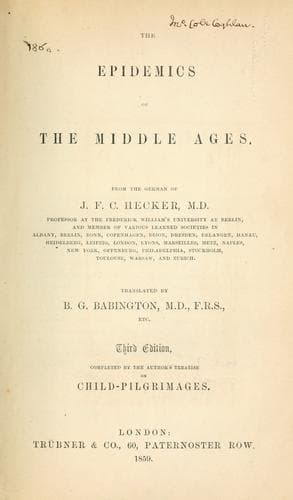
The Epidemics of the Middle AgesHecker, J. F. C. (Justus Friedrich Carl)
History
The Epidemics of the Middle Ages
Hecker, J. F. C. (Justus Friedrich Carl)
Black Death; Epidemics -- History; Hysteria, Epidemic
Without attributing more to deception and fraud than to the peculiar
nature of a progressive mental malady, it may readily be conceived
that the cases of this strange disorder now grew more frequent.
The celebrated Matthioli[265], who is worthy of entire confidence,
gives his account as an eye-witness. He saw the same extraordinary
effects produced by music as Alexandro, for, however tortured with
pain, however hopeless of relief the patients appeared, as they lay
stretched on the couch of sickness, at the very first sounds of those
melodies which made an impression on them—but this was the case only
with the Tarantellas composed expressly for the purpose—they sprang
up as if inspired with new life and spirit, and, unmindful of their
disorder, began to move in measured gestures, dancing for hours
together without fatigue, until, covered with a kindly perspiration,
they felt a salutary degree of lassitude, which relieved them for a
time at least, perhaps even for a whole year, from their dejection and
oppressive feeling of general indisposition. Alexandro’s experience of
the injurious effects resulting from a sudden cessation of the music
was generally confirmed by Matthioli. If the clarinets and drums ceased
for a single moment, which, as the most skilful players were tired out
by the patients, could not but happen occasionally, they suffered their
limbs to fall listless, again sank exhausted to the ground, and could
find no solace but in a renewal of the dance. On this account care was
taken to continue the music until exhaustion was produced; for it was
better to pay a few extra musicians, who might relieve each other,
than to permit the patient, in the midst of this curative exercise, to
relapse into so deplorable a state of suffering. The attack consequent
upon the bite of the Tarantula, Matthioli describes as varying much in
its manner. Some became morbidly exhilarated, so that they remained
for a long while without sleep, laughing, dancing, and singing in a
state of the greatest excitement. Others, on the contrary, were drowsy.
The generality felt nausea and suffered from vomiting, and some had
constant tremors. Complete mania was no uncommon occurrence, not to
mention the usual dejection of spirits and other subordinate symptoms.
SECT. 4.—IDIOSYNCRACIES.—MUSIC.
Public-domain text, read in full here on John Shaqi.
Reviews
Reviews
No reviews yet
Be the first to share your thoughts on this work.
Elsewhere in the archive
Join the Discussion
Join the discussion
Sign in to leave a comment or review.
Sign InorCreate an account