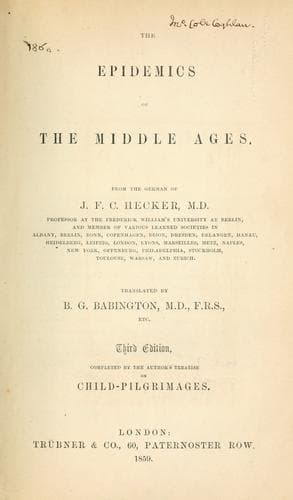
The Epidemics of the Middle AgesHecker, J. F. C. (Justus Friedrich Carl)
History
The Epidemics of the Middle Ages
Hecker, J. F. C. (Justus Friedrich Carl)
Black Death; Epidemics -- History; Hysteria, Epidemic
The music was almost wholly in the Turkish style (aria Turchesca),
and the ancient songs of the peasantry of Apulia, which increased in
number annually, were well suited to the abrupt and lively notes of
the Turkish drum and the shepherd’s pipe. These two instruments were
the favourites in the country, but others of all kinds were played in
towns and villages, as an accompaniment to the dances of the patients
and the songs of the spectators. If any particular melody was disliked
by those affected, they indicated their displeasure by violent gestures
expressive of aversion. They could not endure false notes, and it
is remarkable that uneducated boors, who had never in their lives
manifested any perception of the enchanting power of harmony, acquired,
in this respect, an extremely refined sense of hearing, as if they had
been initiated into the profoundest secrets of the musical art[285].
It was a matter of every day’s experience, that patients showed a
predilection for certain Tarantellas, in preference to others, which
gave rise to the composition of a great variety of these dances. They
were likewise very capricious in their partialities for particular
instruments; so that some longed for the shrill notes of the trumpet,
others for the softest music produced by the vibration of strings[286].
Tarantism was at its greatest height in Italy in the seventeenth
century, long after the St. Vitus’s Dance of Germany had disappeared.
It was not the natives of the country only who were attacked by this
complaint. Foreigners of every colour and of every race, negroes,
gipsies, Spaniards, Albanians, were in like manner affected by it[287].
Against the effects produced by the Tarantula’s bite, or by the sight
of the sufferers, neither youth nor age afforded any protection; so
that even old men of ninety threw aside their crutches at the sound of
the Tarantella, and, as if some magic potion, restorative of youth and
vigour, were flowing through their veins, joined the most extravagant
dancers[288]. Ferdinando saw a boy five years old seized with the
dancing mania[289], in consequence of the bite of a tarantula, and,
what is almost past belief, were it not supported by the testimony of
so credible an eye-witness, even deaf people were not exempt from this
disorder, so potent in its effect was the very sight of those affected,
even without the exhilarating emotions caused by music[290].
Public-domain text, read in full here on John Shaqi.
Reviews
Reviews
No reviews yet
Be the first to share your thoughts on this work.
Elsewhere in the archive
Join the Discussion
Join the discussion
Sign in to leave a comment or review.
Sign InorCreate an account