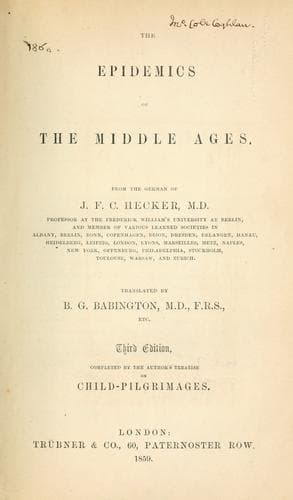
The Epidemics of the Middle AgesHecker, J. F. C. (Justus Friedrich Carl)
History
The Epidemics of the Middle Ages
Hecker, J. F. C. (Justus Friedrich Carl)
Black Death; Epidemics -- History; Hysteria, Epidemic
The music itself was of a kind perfectly adapted to the nature of
the malady, and it made so deep an impression on the Italians, that
even to the present time, long since the extinction of the disorder,
they have retained the Tarantella, as a particular species of music
employed for quick lively dancing. The different kinds of Tarantella
were distinguished, very significantly, by particular names, which had
reference to the moods observed in the patients. Whence it appears that
they aimed at representing by these tunes, even the idiosyncracies of
the mind as expressed in the countenance. Thus there was one kind of
Tarantella which was called “Panno rosso,” a very lively impassioned
style of music, to which wild dithyrambic songs were adapted; another,
called “Panno verde,” which was suited to the milder excitement of the
senses, caused by green colours, and set to Idyllian songs of verdant
fields and shady groves. A third was named “Cinque tempi:” a fourth
“Moresca,” which was played to a Moorish dance; a fifth, “Catena”
and a sixth, with a very appropriate designation, “Spallata,” as if it
were only fit to be played to dancers who were lame in the shoulder.
This was the slowest and least in vogue of all[282]. For those who
loved water they took care to select love songs, which were sung to
corresponding music, and such persons delighted in hearing of gushing
springs and rushing cascades and streams[283]. It is to be regretted
that on this subject we are unable to give any further information, for
only small fragments of songs, and a very few Tarantellas, have been
preserved, which belong to a period so remote as the beginning of the
seventeenth, or at furthest the end of the sixteenth century[284].
Public-domain text, read in full here on John Shaqi.
Reviews
Reviews
No reviews yet
Be the first to share your thoughts on this work.
Elsewhere in the archive