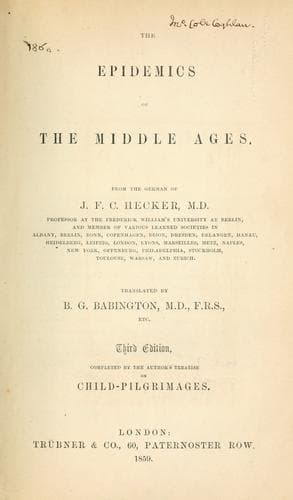
The Epidemics of the Middle AgesHecker, J. F. C. (Justus Friedrich Carl)
History
The Epidemics of the Middle Ages
Hecker, J. F. C. (Justus Friedrich Carl)
Black Death; Epidemics -- History; Hysteria, Epidemic
Different characteristics of morbidly excited vitality having been
rendered prominent by Tarantism in different individuals, it could
not but happen that other derangements of the nerves would assume the
form of this, whenever circumstances favoured such a transition.
This was more especially the case with hysteria, that proteiform and
mutable disorder, in which the imaginations, the superstitions and the
follies of all ages have been evidently reflected. The “Carnevaletto
delle Donne” appeared most opportunely for those who were hysterical.
Their disease received from it, as it had at other times from other
extraordinary customs, a peculiar direction; so that whether bitten
by the tarantula or not, they felt compelled to participate in the
dances of those affected, and to make their appearance at this
popular festival, where they had an opportunity of triumphantly
exhibiting their sufferings. Let us here pause to consider the kind
of life which the women in Italy led. Lonely, and deprived by cruel
custom of social intercourse, that fairest of all enjoyments, they
dragged on a miserable existence. Cheerfulness and an inclination
to sensual pleasures passed into compulsory idleness, and, in many,
into black despondency[304]. Their imaginations became disordered—a
pallid countenance and oppressed respiration bore testimony to their
profound sufferings. How could they do otherwise, sunk as they were
in such extreme misery, than seize the occasion to burst forth from
their prisons, and alleviate their miseries by taking part in the
delights of music. Nor should we here pass unnoticed a circumstance
which illustrates, in a remarkable degree, the psychological nature
of hysterical sufferings, namely, that many chlorotic females, by
joining the dancers at the Carnevaletto, were freed from their spasms
and oppression of breathing for the whole year, although the corporeal
cause of their malady was not removed[305]. After such a result, no one
could call their self-deception a mere imposture, and unconditionally
condemn it as such.
Public-domain text, read in full here on John Shaqi.
Reviews
Reviews
No reviews yet
Be the first to share your thoughts on this work.
Elsewhere in the archive
Join the Discussion
Join the discussion
Sign in to leave a comment or review.
Sign InorCreate an account