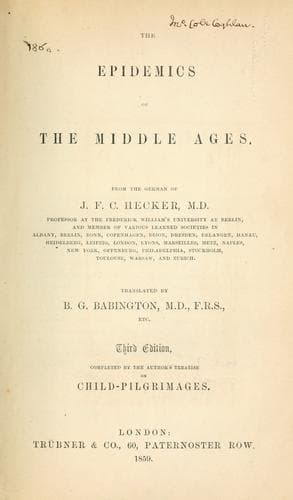
The Epidemics of the Middle AgesHecker, J. F. C. (Justus Friedrich Carl)
History
The Epidemics of the Middle Ages
Hecker, J. F. C. (Justus Friedrich Carl)
Black Death; Epidemics -- History; Hysteria, Epidemic
This numerous class of patients certainly contributed not a little to
the maintenance of the evil, for their fantastic sufferings, in which
dissimulation and reality could scarcely be distinguished even by
themselves, much less by their physicians, were imitated, in the same
way as the distortions of the St. Vitus’s dancers, by the impostors of
that period. It was certainly by these persons also that the number
of subordinate symptoms was increased to an endless extent, as may
be conceived from the daily observation of hysterical patients, who,
from a morbid desire to render themselves remarkable, deviate from the
laws of moral propriety. Powerful sexual excitement had often the most
decided influence over their condition. Many of them exposed themselves
in the most indecent manner, tore their hair out by the roots, with
howling and gnashing of their teeth; and when, as was sometimes the
case, their unsatisfied passion hurried them on to a state of frenzy,
they closed their existence by self-destruction; it being common at
that time for these unfortunate beings to precipitate themselves into
the wells[306].
It might hence seem that, owing to the conduct of patients of this
description, so much of fraud and falsehood would be mixed up with the
original disorder, that having passed into another complaint, it must
have been itself destroyed. This, however, did not happen in the first
half of the seventeenth century; for as a clear proof that Tarantism
remained substantially the same and quite unaffected by Hysteria,
there were in many places, and in particular at Messapia, fewer women
affected than men, who in their turn were, in no small proportion, led
into temptation by sexual excitement[307]. In other places, as for
example at Brindisi, the case was reversed, which may, as in other
complaints, be in some measure attributable to local causes. Upon the
whole it appears, from concurrent accounts, that women by no means
enjoyed the distinction of being attacked by Tarantism more frequently
than men.
It is said that the cicatrix of the tarantula bite, on the yearly or
half-yearly return of the fit, became discoloured[308], but on this
point the distinct testimony of good observers is wanting to deprive
the assertion of its utter improbability.
Public-domain text, read in full here on John Shaqi.
Reviews
Reviews
No reviews yet
Be the first to share your thoughts on this work.
Elsewhere in the archive
Join the Discussion
Join the discussion
Sign in to leave a comment or review.
Sign InorCreate an account