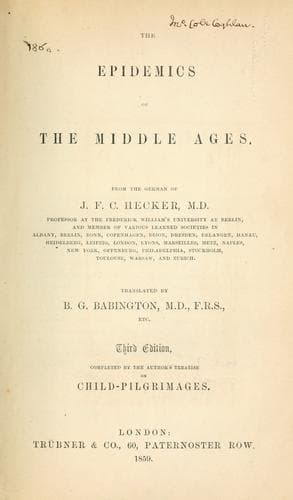
The Epidemics of the Middle AgesHecker, J. F. C. (Justus Friedrich Carl)
History
The Epidemics of the Middle Ages
Hecker, J. F. C. (Justus Friedrich Carl)
Black Death; Epidemics -- History; Hysteria, Epidemic
Both the St. Vitus’s dance and Tarantism belonged to the ages in which
they appeared. They could not have existed under the same latitude at
any other epoch, for at no other period were the circumstances which
prepared the way for them combined in a similar relation to each other,
and the mental as well as corporeal temperaments of nations, which
depend on causes such as have been stated, are as little capable of
renewal as the different stages of life in individuals. This gives
so much the more importance to a disease but cursorily alluded to
in the foregoing pages, which exists in Abyssinia, and which nearly
resembles the original mania of the St. John’s dancers, inasmuch as it
exhibits a perfectly similar ecstacy, with the same violent effect on
the nerves of motion. It occurs most frequently in the Tigrè country,
being thence called Tigretier, and is probably the same malady which is
called in the Æthiopian language Astarāgaza[317]. On this subject we
will introduce the testimony of Nathaniel Pearce[318], an eye-witness,
who resided nine years in Abyssinia. “The Tigretier,” says he, “is
more common among the women than among the men. It seizes the body as
if with a violent fever, and from that turns to a lingering sickness,
which reduces the patients to skeletons, and often kills them, if the
relations cannot procure the proper remedy. During this sickness their
speech is changed to a kind of stuttering, which no one can understand
but those afflicted with the same disorder. When the relations find
the malady to be the real _tigretier_, they join together to defray
the expenses of curing it; the first remedy they in general attempt,
is to procure the assistance of a learned Dofter, who reads the Gospel
of St. John[319], and drenches the patient with cold water daily for
the space of seven days—an application that very often proves fatal.
The most effectual cure, though far more expensive than the former, is
as follows:—The relations hire, for a certain sum of money, a band of
trumpeters, drummers and fifers, and buy a quantity of liquor; then all
the young men and women of the place assemble at the patient’s house,
to perform the following most extraordinary ceremony.
Public-domain text, read in full here on John Shaqi.
Reviews
Reviews
No reviews yet
Be the first to share your thoughts on this work.
Elsewhere in the archive
Join the Discussion
Join the discussion
Sign in to leave a comment or review.
Sign InorCreate an account