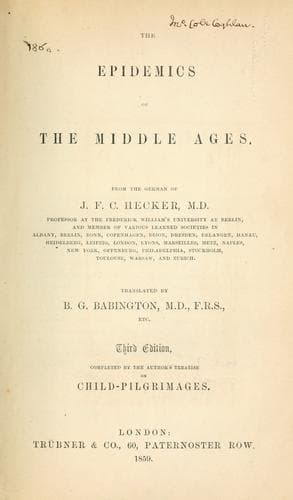
The Epidemics of the Middle AgesHecker, J. F. C. (Justus Friedrich Carl)
History
The Epidemics of the Middle Ages
Hecker, J. F. C. (Justus Friedrich Carl)
Black Death; Epidemics -- History; Hysteria, Epidemic
To conclude. Tarantism, as a real disease, has been denied _in toto_,
and stigmatized as an imposition, by most physicians and naturalists,
who in this controversy have shown the narrowness of their views and
their utter ignorance of history. In order to support their opinion
they have instituted some experiments, apparently favourable to it,
but under circumstances altogether inapplicable, since, for the most
part, they selected, as the subjects of them, none but healthy men,
who were totally uninfluenced by a belief in this once so dreaded
disease. From individual instances of fraud and dissimulation, such as
are found in connexion with most nervous affections without rendering
their reality a matter of any doubt, they drew a too hasty conclusion
respecting the general phenomenon, of which they appeared not to know,
that it had continued for nearly four hundred years, having originated
in the remotest periods of the middle ages. The most learned and the
most acute among these sceptics is Serao the Neapolitan[313]. His
reasonings amount to this, that he considers the disease to be a very
marked form of melancholia, and compares the effect of the tarantula
bite upon it to stimulating, with spurs, a horse which is already
running. The reality of that effect he thus admits, and therefore
directly confirms what in appearance only he denies[314]. By shaking
the already vacillating belief in this disorder he is said to have
actually succeeded in rendering it less frequent, and in setting bounds
to imposture[315]; but this no more disproves the reality of its
existence, than the oft-repeated detection of imposition has been able,
in modern times, to banish magnetic sleep from the circle of natural
phenomena, though such detection has, on its side, rendered more rare
the incontestible effects of animal magnetism. Other physicians and
naturalists[316] have delivered their sentiments on Tarantism, but as
they have not possessed an enlarged knowledge of its history, their
views do not merit particular exposition. It is sufficient for the
comprehension of every one, that we have presented the facts freed from
all extraneous speculation.
CHAPTER III.
DANCING MANIA IN ABYSSINIA.
SECT. 1.—TIGRETIER.
Public-domain text, read in full here on John Shaqi.
Reviews
Reviews
No reviews yet
Be the first to share your thoughts on this work.
Elsewhere in the archive
Join the Discussion
Join the discussion
Sign in to leave a comment or review.
Sign InorCreate an account