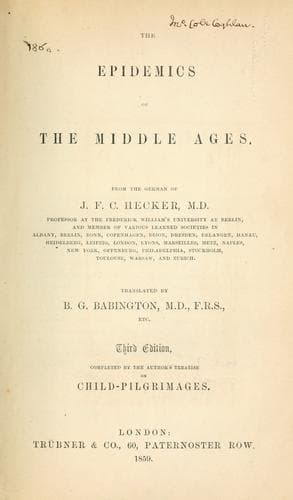
The Epidemics of the Middle AgesHecker, J. F. C. (Justus Friedrich Carl)
History
The Epidemics of the Middle Ages
Hecker, J. F. C. (Justus Friedrich Carl)
Black Death; Epidemics -- History; Hysteria, Epidemic
“I could not have ventured to write this from hearsay, nor could
I conceive it possible, until I was obliged to put this remedy in
practice upon my own wife[320], who was seized with the same disorder,
and then I was compelled to have a still nearer view of this strange
disorder. I at first thought that a whip would be of some service, and
one day attempted a few strokes when unnoticed by any person, we being
by ourselves, and I having a strong suspicion that this ailment sprang
from the weak minds of women, who were encouraged in it for the sake
of the grandeur, rich dress, and music which accompany the cure. But
how much was I surprised, the moment I struck a light blow, thinking to
do good, to find that she became like a corpse, and even the joints of
her fingers became so stiff that I could not straighten them; indeed,
I really thought that she was dead, and immediately made it known to
the people in the house that she had fainted, but did not tell them the
cause, upon which they immediately brought music, which I had for many
days denied them, and which soon revived her; and I then left the house
to her relations to cure her at my expense, in the manner I have before
mentioned, though it took a much longer time to cure my wife than the
woman I have just given an account of. One day I went privately, with
a companion, to see my wife dance, and kept at a short distance, as
I was ashamed to go near the crowd. On looking stedfastly upon her,
while dancing or jumping more like a deer than a human being, I said
that it certainly was not my wife; at which my companion burst into
a fit of laughter, from which he could scarcely refrain all the way
home. Men are sometimes afflicted with this dreadful disorder, but not
frequently. Among the Amhara and Galla it is not so common.”
Such is the account of Pearce, who is every way worthy of credit,
and whose lively description renders the traditions of former times
respecting the St. Vitus’s dance and Tarantism intelligible even
to those who are sceptical respecting the existence of a morbid
state of the mind and body of the kind described, because, in the
present advanced state of civilization among the nations of Europe,
opportunities for its development no longer occur. The credibility
of this energetic, but by no means ambitious man, is not liable to
the slightest suspicion, for, owing to his want of education, he had
no knowledge of the phenomenon in question, and his work evinces
throughout his attractive and unpretending impartiality.
Public-domain text, read in full here on John Shaqi.
Reviews
Reviews
No reviews yet
Be the first to share your thoughts on this work.
Elsewhere in the archive
Join the Discussion
Join the discussion
Sign in to leave a comment or review.
Sign InorCreate an account