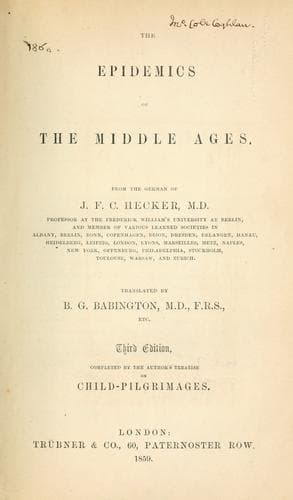
The Epidemics of the Middle AgesHecker, J. F. C. (Justus Friedrich Carl)
History
The Epidemics of the Middle Ages
Hecker, J. F. C. (Justus Friedrich Carl)
Black Death; Epidemics -- History; Hysteria, Epidemic
Comparison is the mother of observation, and may here elucidate one
phenomena by another—the past by that which still exists. Oppression,
insecurity, and the influence of a very rude priestcraft, are the
powerful causes which operated on the Germans and Italians of the
middle ages, as they now continue to operate on the Abyssinians of the
present day. However these people may differ from us in their descent,
their manners and their customs, the effects of the above-mentioned
causes are the same in Africa as they were in Europe, for they operate
on man himself independently of the particular locality in which he may
be planted; and the condition of the Abyssinians of modern times is,
in regard to superstition, a mirror of the condition of the European
nations in the middle ages. Should this appear a bold assertion, it
will be strengthened by the fact, that in Abyssinia, two examples
of superstitions occur, which are completely in accordance with
occurrences of the middle ages that took place contemporarily with the
dancing mania. _The Abyssinians have their Christian flagellants, and
there exists among them a belief in a Zoomorphism, which presents a
lively image of the lycanthropy of the middle ages._ Their flagellants
are called Zackarys. They are united into a separate Christian
fraternity, and make their processions through the towns and villages
with great noise and tumult, scourging themselves till they draw blood,
and wounding themselves with knives[321]. They boast that they are
descendants of St. George. It is precisely in Tigrè, the country of the
Abyssinian dancing mania, where they are found in the greatest numbers,
and where they have, in the neighbourhood of Axum, a church of their
own, dedicated to their patron saint _Oun Arvel_. Here there is an
ever-burning lamp, and they contrive to impress a belief that this is
kept alight by supernatural means. They also here keep a holy water,
which is said to be a cure for those who are affected by the dancing
mania.
Public-domain text, read in full here on John Shaqi.
Reviews
Reviews
No reviews yet
Be the first to share your thoughts on this work.
Elsewhere in the archive
Join the Discussion
Join the discussion
Sign in to leave a comment or review.
Sign InorCreate an account