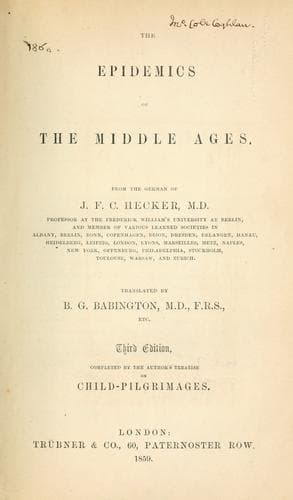
The Epidemics of the Middle AgesHecker, J. F. C. (Justus Friedrich Carl)
History
The Epidemics of the Middle Ages
Hecker, J. F. C. (Justus Friedrich Carl)
Black Death; Epidemics -- History; Hysteria, Epidemic
I by no means wish it to be understood, that I have adopted the
author’s views respecting astral and telluric influences, the former of
which, at least, I had supposed to have been, with alchemy and magic,
long since consigned to oblivion; much less am I prepared to accede
to his notion, or rather an ancient notion derived from the East and
revived by him, of an organic life in the system of the universe. We
are constantly furnished with proofs, that that which affects life is
not itself alive; and whether we look to the earth for exhalations,
to the air for electrical phenomena, to the heavenly bodies for an
influence over our planet, or to all these causes combined, for the
formation of some unknown principle noxious to animal existence, still,
if we found our reasoning on ascertained facts, we can perceive nothing
throughout this vast field for physical research which is not evidently
governed by the laws of inert matter—nothing which resembles the
regular succession of birth, growth, decay, death, and regeneration,
observable in organized beings. To assume, therefore, causes of whose
existence we have no proof, in order to account for effects which,
after all, they do not explain, is making no real advance in knowledge,
and can scarcely be considered otherwise than an indirect method of
confessing our ignorance.
Still, however, I regard the author’s opinions, illustrated as they are
by a series of interesting facts diligently collected from authentic
sources, as, at least, worthy of examination before we reject them, and
valuable, as furnishing extensive data on which to build new theories.
I have another, perhaps I may be allowed to say a better, motive for
laying before my countrymen this narrative of the sufferings of past
ages,—that by comparing them with those of our own time, we may be made
the more sensible how lightly the chastening hand of Providence has
fallen on the present generation, and how much reason, therefore, we
have to feel grateful for the mercy shown us.
The publication has, with this view, been purposely somewhat delayed,
in order that it might appear at a moment when it is to be presumed
that men’s thoughts will be especially directed to the approaching
hour of public thanksgiving, and when a knowledge of that which they
have escaped, as well as of that which they have suffered, may tend to
heighten their devotional feelings on that solemn occasion.
When we learn that, in the fourteenth century, one quarter, at least,
of the population of the old world was swept away in the short space of
four years, and that some countries, England among the rest, lost more
than double that proportion of their inhabitants in the course of a few
months, we may well congratulate ourselves that our visitation has not
been like theirs, and shall not justly merit ridicule, if we offer our
humble thanks to the “Creator and Preserver of all mankind” for our
deliverance.
Public-domain text, read in full here on John Shaqi.
Reviews
Reviews
No reviews yet
Be the first to share your thoughts on this work.
Join the Discussion
Join the discussion
Sign in to leave a comment or review.
Sign InorCreate an account