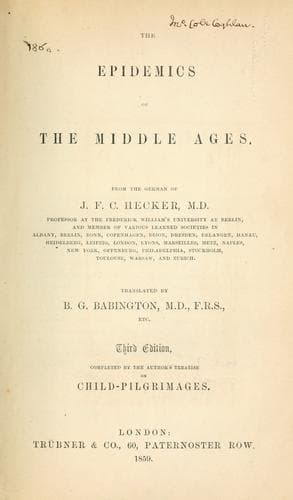
The Epidemics of the Middle AgesHecker, J. F. C. (Justus Friedrich Carl)
History
The Epidemics of the Middle Ages
Hecker, J. F. C. (Justus Friedrich Carl)
Black Death; Epidemics -- History; Hysteria, Epidemic
“The disease no sooner appeared, than it spread with rapidity through
the medium of the principle of imitation; thus it was not uncommon for
an affected person to communicate it to the greater part of a crowd,
who, from curiosity or other motives, had collected around him. It is
at this time, in almost every part of Tennessee and Kentucky, and in
various parts of Virginia, but is said not to be contagious (or readily
communicated) as at its commencement. It attacks both sexes, and every
constitution, but evidently more readily those who are enthusiasts in
religion, such as those above described, and females; children of six
years of age, and adults of sixty, have been known to have it, but a
great majority of those affected are from fifteen to twenty-five. The
muscles generally affected are those of the trunk, particularly of the
neck, sometimes those of the superior extremities, but very rarely, if
ever, those of the inferior. The contractions are sudden and violent,
such as are denominated convulsive, being sometimes so powerful, when
in the muscles of the back, that the patient is thrown on the ground,
where, for some time, his motions more resemble those of a live fish,
when thrown on land, than any thing else to which I can compare them.
“This, however, does not often occur, and never, I believe, except at
the commencement of the disease. The patients, in general, are capable
of standing and walking, and many, after it has continued a short time,
can attend to their business, provided it is not of a nature requiring
much steadiness of body. They are incapable of conversing with any
degree of satisfaction to themselves or company, being continually
interrupted by those irregular contractions of their muscles, each
causing a grunt, or forcible expiration; but the organs of speech do
not appear to be affected, nor has it the least influence on the mind.
They have no command over their actions by any effort of volition, nor
does their lying in bed prevent them, but they always cease during
sleep. This disease has remissions and exacerbations, which, however,
observe no regularity in their occurrence or duration. During the
intermission a paroxysm is often excited at the sight of a person
affected, but more frequently by the common salute of shaking hands.
The sensations of the patients in a paroxysm are generally agreeable,
which the enthusiastic class often endeavour to express, by laughing,
shouting, _dancing_, &c.
Public-domain text, read in full here on John Shaqi.
Reviews
Reviews
No reviews yet
Be the first to share your thoughts on this work.
Elsewhere in the archive
Join the Discussion
Join the discussion
Sign in to leave a comment or review.
Sign InorCreate an account