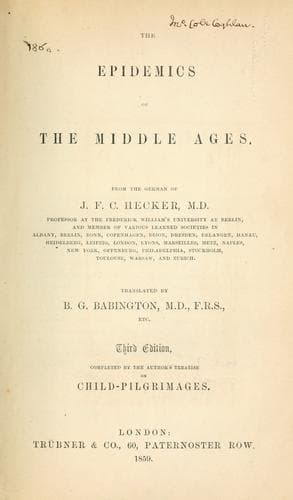
The Epidemics of the Middle AgesHecker, J. F. C. (Justus Friedrich Carl)
History
The Epidemics of the Middle Ages
Hecker, J. F. C. (Justus Friedrich Carl)
Black Death; Epidemics -- History; Hysteria, Epidemic
| public market-place, the lanes, and the streets of Strasburg. Many |
| of them ate nothing for days and nights, until their mania again |
| subsided. The plague was called St. Vitus’s Dance.” |
| |
| [218] _Cæs. Baron._ Annales ecclesiastic. Tom. II. p. 819. Colon. |
| Agripp. 1609. fol. See the more ample Acta Sanctorum Junii (The |
| 15th of June is St. Vitus’s day) Tom. II. p. 1013. Antwerp. 1698. |
| fol. From which we shall merely add that Mazara, in Sicily, is |
| supposed to have been the birth-place of our Saint, and that |
| his father’s name was _Hylas_; that he went from thence with |
| _Crescentia_ (probably his nurse) and _Modestus_ to Lucania, with |
| both of whom he suffered martyrdom under _Diocletian_. They are all |
| said to have been buried at Florence, and it was not long before |
| the miraculous powers of St. Vitus, which had already manifested |
| themselves in his life-time, were acknowledged throughout Italy. |
| The most celebrated of his chapels were situated on the Promontory |
| of Sicily (called by his name), in Rome and in Polignano, whither |
| many pilgrimages were made by the sick. Persons who had been bitten |
| by mad dogs believed that they would find an infallible cure at |
| his altars, though the power of the Saint in curing wounds of this |
| kind was afterwards disputed by the followers of St. Hubertus, the |
| Saint of the Chase. In 672, his body was with much pomp moved to |
| Apulia, but soon after the priests of many churches and chapels |
| in Italy, gave out that they were in possession of portions of |
| the saint’s body which worked miracles. In the eighth century the |
| veneration of this youthful martyr extended itself to France, and |
| the honour of possessing his body was conferred on the church of |
| St. Denys. By command of the Pope it was solemnly delivered on |
| the 19th of March, 836, by the Abbot _Hilduwinus_, of St. Denys, |
| to the Abbot _Warinus_, of Corvey, (founded in 822). On its way |
| thither, which occupied three months (to the 13th of June), many |
| miracles were performed, and the subsequent Abbots of Corvey were |
| able for centuries to maintain the popular belief in the miraculous |
| healing power of their relics, which had indiscriminate influence |
| on all diseases, more especially on those of a demoniacal kind. See |
| Monachi anonymi Historia translationis S. Viti. In _G. H. Pertz_, |
| Monumenta Germaniæ Historica. Tom. II. Hannov. 1828. fol. p. 576. |
| As a proof of the great veneration for St. Vitus in the fourteenth |
| century, we may further mention that Charles IV. dedicated to him |
| the Cathedral of Prague, of which he had laid the foundation, and |
| caused him to be proclaimed Patron Saint of Bohemia, and a nominal |
Public-domain text, read in full here on John Shaqi.
Reviews
Reviews
No reviews yet
Be the first to share your thoughts on this work.
Elsewhere in the archive
Join the Discussion
Join the discussion
Sign in to leave a comment or review.
Sign InorCreate an account