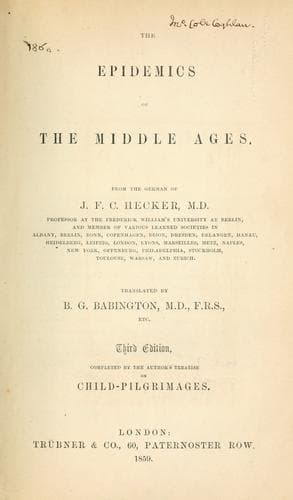
The Epidemics of the Middle AgesHecker, J. F. C. (Justus Friedrich Carl)
History
The Epidemics of the Middle Ages
Hecker, J. F. C. (Justus Friedrich Carl)
Black Death; Epidemics -- History; Hysteria, Epidemic
The most memorable example of what has been advanced, is afforded
by a great pestilence of the fourteenth century, which desolated
Asia, Europe, and Africa, and of which the people yet preserve the
remembrance in gloomy traditions. It was an oriental plague, marked by
inflammatory boils and tumours of the glands, such as break out in no
other febrile disease. On account of these inflammatory boils, and from
the black spots, indicatory of a putrid decomposition, which appeared
upon the skin, it was called in Germany and in the northern kingdoms
of Europe, _the Black Death_, and in Italy, la Mortalega Grande, _the
Great Mortality_[4].
Few testimonies are presented to us respecting its symptoms and its
course, yet these are sufficient to throw light upon the form of the
malady, and they are worthy of credence, from their coincidence with
the signs of the same disease in modern times.
The imperial writer, Kantakusenos[5], whose own son, Andronikus, died
of this plague in Constantinople, notices great imposthumes[6] of
the thighs and arms of those affected, which, when opened, afforded
relief by the discharge of an offensive matter. Buboes, which are the
infallible signs of the oriental plague, are thus plainly indicated,
for he makes separate mention of smaller boils on the arms and in the
face, as also in other parts of the body, and clearly distinguishes
these from the blisters[7], which are no less produced by plague in all
its forms. In many cases, black spots[8] broke out all over the body,
either single, or united and confluent.
These symptoms were not all found in every case. In many, one alone was
sufficient to cause death, while some patients recovered, contrary to
expectation, though afflicted with all. Symptoms of cephalic affection
were frequent; many patients became stupified and fell into a deep
sleep, losing also their speech from palsy of the tongue; others
remained sleepless and without rest. The fauces and tongue were black,
and as if suffused with blood; no beverage would assuage their burning
thirst, so that their sufferings continued without alleviation until
terminated by death, which many in their despair accelerated with their
own hands. Contagion was evident, for attendants caught the disease of
their relations and friends, and many houses in the capital were bereft
even of their last inhabitant. Thus far the ordinary circumstances only
of the oriental plague occurred. Still deeper sufferings, however,
were connected with this pestilence, such as have not been felt at
other times; the organs of respiration were seized with a putrid
inflammation; a violent pain in the chest attacked the patient; blood
was expectorated, and the breath diffused a pestiferous odour.
Public-domain text, read in full here on John Shaqi.
Reviews
Reviews
No reviews yet
Be the first to share your thoughts on this work.
Join the Discussion
Join the discussion
Sign in to leave a comment or review.
Sign InorCreate an account