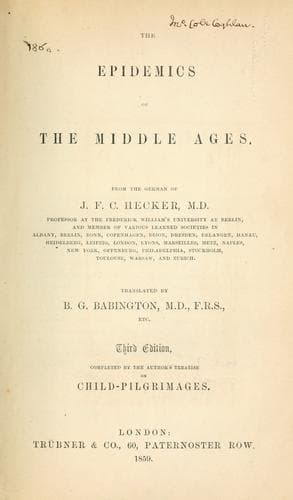
The Epidemics of the Middle AgesHecker, J. F. C. (Justus Friedrich Carl)
History
The Epidemics of the Middle Ages
Hecker, J. F. C. (Justus Friedrich Carl)
Black Death; Epidemics -- History; Hysteria, Epidemic
After the fate of England had been decided by the battle of Bosworth,
on the 22d of August, 1485[349], the joy of the nation was clouded
by a mortal disease which thinned the ranks of the warriors, and
following in the rear of Henry’s victorious army, spread in a few weeks
from the distant mountains of Wales to the metropolis of the empire.
It was a violent inflammatory fever, which, after a short rigor,
prostrated the powers as with a blow; and amidst painful oppression
at the stomach, headache and lethargic stupor, suffused the whole
body with a fetid perspiration. All this took place in the course of
a few hours, and the crisis was always over within the space of a
day and night[350]. The internal heat which the patient suffered was
intolerable, yet every refrigerant was certain death. The people were
seized with consternation when they saw that scarcely one in a hundred
escaped[351], and their first impression was that a reign commencing
with such horrors would doubtless prove most inauspicious[352].
At first the new foe was scarcely heeded; citizens and peasants went
in joyful processions to meet the victorious army. Henry’s march from
Bosworth towards London resembled a triumph, which was everywhere
celebrated by festivals; for the nation, after its many years of civil
war, looked forward to happier days than they had enjoyed under the
blood-thirsty Richard.
Very shortly, however, after the king’s entry into the capital on
the 28th of August[353], the Sweating Sickness[354], as the disease
was called, began to spread its ravages among the densely peopled
streets of the city. Two lord mayors and six aldermen died within one
week[355], having scarcely laid aside their festive robes; many who
had been in perfect health at night, were on the following morning
numbered among the dead. The disease for the most part marked for its
victims robust and vigorous men; and as many noble families lost their
chiefs, extensive commercial houses their principals, and wards their
guardians, the festivities were soon converted into grief and mourning.
The coronation of the king, which was expected to overcome the scruples
that many entertained of his right to the throne, was of necessity
postponed in this general distress[356], and the disease, in the mean
time, spread without interruption and over the whole kingdom from east
to west[357].
Public-domain text, read in full here on John Shaqi.
Reviews
Reviews
No reviews yet
Be the first to share your thoughts on this work.
Elsewhere in the archive
Join the Discussion
Join the discussion
Sign in to leave a comment or review.
Sign InorCreate an account