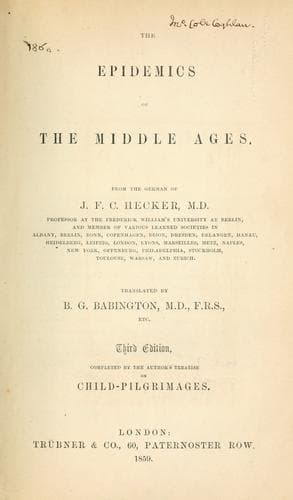
The Epidemics of the Middle AgesHecker, J. F. C. (Justus Friedrich Carl)
History
The Epidemics of the Middle Ages
Hecker, J. F. C. (Justus Friedrich Carl)
Black Death; Epidemics -- History; Hysteria, Epidemic
It is agreed that the pestilence did not commence till the very
beginning of August, 1485, and was in obvious connexion with the
circumstances of the times. To return to their native country had
long been the ardent desire of the Earl of Richmond and his faithful
followers. At the age of 15, (1471,) having escaped the vengeance of
the House of York, and the assassins of Edward, he was overtaken by
a storm, and fell into the hands of Francis II., Duke of Bretagne,
who long detained him prisoner, but on the death of Edward, in 1483,
supplied him with means to enforce his claims to the English throne, as
the last descendant of the House of Lancaster. This first undertaking
miscarried. A storm drove back the bold adventurer to Dieppe, and
compelled him once more to throw himself, with his five hundred English
followers, on the hospitality of Duke Francis. Richard’s influence
with the Duke, however, rendered his stay there somewhat dangerous.
Richmond withdrew privately, and endeavoured to gain over to his cause
Charles VIII., who was yet a minor. A small subsidy of French troops,
some pieces of artillery, and an adequate supply of money, were finally
granted to his repeated solicitations. This little band was quickly
augmented to 2000 men, who were all embarked, and on the 25th of July,
1485, they weighed anchor at Havre, and seven days after, the standard
of Richmond was raised in Milford Haven[358].
They landed at the village of Dale, on the west side of the harbour,
and on the evening of their arrival, or very early on the following
morning, Richmond hastened to Haverfordwest, where no messenger had
yet announced the renewal of the civil war. It appears that he reached
Cardigan, on the northern shore, on the 3d of August, and for the
first time granted to his small but increasing army the repose of an
encampment.
After a short halt, he set forward with confidence, crossed the Severn
at Shrewsbury[359], turned from thence to Newport and Stafford,
and pitched his camp at Litchfield, probably before the 18th of
August[360]. The distance to this place from Milford Haven is 170
miles, and the road leads over wooded mountains and cultivated fields,
without touching upon any swampy lands. Litchfield, however, lies low,
and it was here that the army encamped in a damp situation, till it
broke up for the neighbouring field of Bosworth. Thither Richmond, with
scarcely 5000 men, and having his right wing covered by a morass, went
to meet his deadly foe, whose army doubled his own. The combat was at
first furious, but in two hours Lord Stanley crowned the conqueror with
Richard’s diadem[361].
Public-domain text, read in full here on John Shaqi.
Reviews
Reviews
No reviews yet
Be the first to share your thoughts on this work.
Elsewhere in the archive
Join the Discussion
Join the discussion
Sign in to leave a comment or review.
Sign InorCreate an account