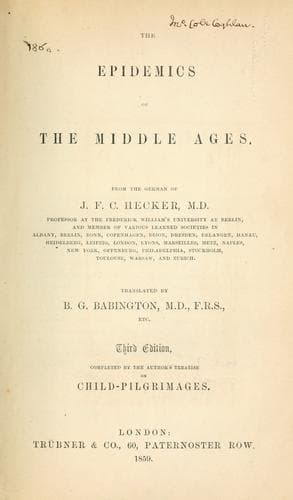
The Epidemics of the Middle AgesHecker, J. F. C. (Justus Friedrich Carl)
History
The Epidemics of the Middle Ages
Hecker, J. F. C. (Justus Friedrich Carl)
Black Death; Epidemics -- History; Hysteria, Epidemic
The “Schwarze Tod,” or “Black Death,” was published in 1832; and I
was prompted to undertake its translation, from a belief that it
would prove interesting at a moment when another fearful epidemic, the
Cholera, with which it admitted of comparison in several particulars,
was fresh in the memory of men. The “Tanzwuth,” or “Dancing Mania,”
came out shortly afterwards; and, as it appeared to me that, though
relating to a less terrific visitation, it possessed an equal share of
interest, and, holding a kind of middle place between a physical and a
moral pestilence, furnished subject of contemplation for the general
as well as the professional reader, I determined on adding it also to
our common stock of medical literature. When the “Englische Schweiss,”
or “Sweating Sickness,” which contained much collateral matter little
known in England, and which completed the history of the principal
epidemics of the middle ages, appeared in 1834, I proceeded to finish
my task; but failing in the accomplishment of certain arrangements
connected with its publication, I laid aside my translation for the
time under a hope, which has at length been fulfilled, that at some
future more auspicious moment, it might yet see the light.
It must not be supposed that the author, in thus taking up the history
of three of the most important epidemics of the middle ages, although
he has illustrated them by less detailed notices of several others,
considers that he has exhausted his subject; on the contrary, it is his
belief, that, in order to come at the secret springs of these general
morbific influences, a most minute as well as a most extended survey
of them, such as can be made only by the united efforts of many, is
required. He would seem to aim at collecting together such a number of
facts from the medical history of all countries and of all ages, as may
at length enable us to deal with epidemics in the same way as Louis has
dealt with individual diseases; and thus by a numerical arrangement of
data, together with a just consideration of their relative value, to
arrive at the discovery of general laws. The present work, therefore,
is but one stone of an edifice, for the construction of which he
invites medical men in all parts of the world to furnish materials[1].
Public-domain text, read in full here on John Shaqi.
Reviews
Reviews
No reviews yet
Be the first to share your thoughts on this work.
Join the Discussion
Join the discussion
Sign in to leave a comment or review.
Sign InorCreate an account