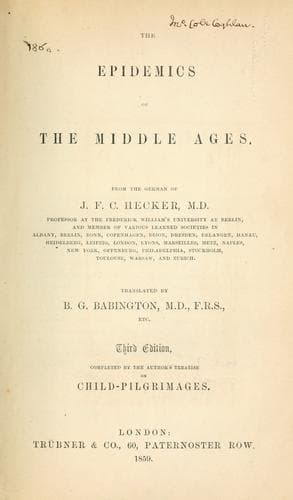
The Epidemics of the Middle AgesHecker, J. F. C. (Justus Friedrich Carl)
History
The Epidemics of the Middle Ages
Hecker, J. F. C. (Justus Friedrich Carl)
Black Death; Epidemics -- History; Hysteria, Epidemic
During the whole of this period the nations of Europe were visited
with various and destructive plagues. In 1477, the Bubo-plague
broke out in Italy, and raged without interruption till 1485[382].
It was accompanied by striking natural phenomena, among which we
may reckon an enormous flight of locusts in 1478[383] and 1482, and
remarkable inter-current diseases, such as inflammatory pain in the
side, throughout the whole of Italy in 1482[384]. In Switzerland and
Southern Germany malignant epidemics[385] appeared in the train of
drought and famine in 1480 and 1481, while putrid fever accompanied by
phrenites[386], prevailed in Westphalia, Hesse and Friesland. There had
never been in the memory of the inhabitants of these districts so many
ignes fatui as during this period. There too the people suffered from
the failure of the harvest, so that it was necessary to obtain supplies
from Thuringen[387]. France, where, under the fearful reign of Louis
XI., oppression and misery seemed to mock the gifts of heaven, became
in 1482, after a two years’ scarcity, the scene of a devastating
plague. It was an inflammatory fever with delirium, accompanied by such
intense pain in the head, that many dashed out their brains against
the wall, or rushed into the water; while others, after incessantly
running to and fro, died in a state of the greatest agony. According
to the notion of the age, this disease was attributed to astral
influences, for it could not have been brought on only by famine,
which left to the poor peasantry, south of the Loire, nothing but the
roots of wild herbs to support their miserable existence[388], since
the higher classes were also frequently attacked[389]. This fever was
without doubt accompanied by inflammation of the meninges, or even of
the brain itself, and was, perhaps, identical with that which at the
same period desolated the north-west of Germany as far as the shores
of the North Sea, only that it was heightened by the greater natural
vivacity and miserable situation of the French people, who were kept
in a state of perpetual dread by the cruel executions of Louis[390].
This pestilence occasioned the king to follow the advice of his morose
physician[391] in ordinary, and to keep himself closely confined within
the town of Plessis des Tours. It was prohibited under a heavy penalty
to speak in his presence of death which was carrying off its victims in
all directions, and forty crossbowmen kept guard in the fosse of the
castle to put to death every living thing which might approach[392].
Two years after, in 1484, virulent diseases[393] again visited Germany
and Switzerland; and thus it seemed as if the nations were everywhere
threatened with death and destruction.
SECT. 5.—RICHMOND’S ARMY.
Public-domain text, read in full here on John Shaqi.
Reviews
Reviews
No reviews yet
Be the first to share your thoughts on this work.
Elsewhere in the archive
Join the Discussion
Join the discussion
Sign in to leave a comment or review.
Sign InorCreate an account