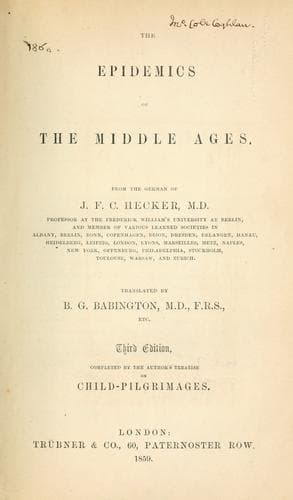
The Epidemics of the Middle AgesHecker, J. F. C. (Justus Friedrich Carl)
History
The Epidemics of the Middle Ages
Hecker, J. F. C. (Justus Friedrich Carl)
Black Death; Epidemics -- History; Hysteria, Epidemic
It was thought remarkable, even at that time, that the Sweating
Sickness did not extend beyond the limits of England, and that,
remaining the unenviable property of that nation, it did not even
spread to Scotland, Ireland, or Calais which belonged to Britain. Much,
doubtless, was owing to the peculiarity of the climate, more still to
atmospherical changes, and something also to the habits of the people
and the circumstances of the times. It plainly appeared in the sequel
that the English Sweating Sickness was a spirit of the mist, which
hovered amid the dark clouds. Even in ordinary years, the atmosphere
of England is loaded with these clouds during considerable periods,
and in damp seasons they would prove the more injurious to health,
as the English of those times were not accustomed to cleanliness,
moderation in their diet, or even comfortable refinements. Gluttony
was common among the nobility as well as among the lower classes; all
were immoderately addicted to drinking[376], and the manners of the age
sanctioned this excess at their banquets and their festivities. If we
consider that the disease mostly attacked strong and robust men—that
portion of the people who abandoned themselves without restraint to
all the pleasures of the table—while women, old men, and children,
almost entirely escaped, it is obvious that a gross indulgence of the
appetite must have had a considerable share in the production of this
unparalleled plague.
To this may be added, the humidity of the year 1485, which is
represented by most chronicles as very remarkable[377]. Throughout
the whole of Europe the rain fell in torrents, and inundations were
frequent. Damp weather is not prejudicial to health if it be merely
temporary, but if the rain be excessive for a series of years, so that
the ground is completely saturated, and the mists attract baneful
exhalations out of the earth, man must necessarily suffer from the
noxious state of the soil and atmosphere. Under these circumstances
epidemics must inevitably follow. The five preceding years had been
unusually wet[378], 1485 proved equally so; the last hot and droughty
summer was that of 1479[379]. Extensive inundations of the Tiber,
the Po, the Danube, the Rhine, and most of the other great rivers,
took place in 1480, and were attended with the usual consequences,
the deterioration of the air, misery and disease[380]. The greatest
inundation ever remembered in England was that of the Severn, in
October, 1483. It was long afterwards called the Duke of Buckingham’s
Great Water[381], because it frustrated the rebellion of this powerful
subject against Richard III., whom he had been instrumental in placing
upon the throne; and consequently defeated also the first enterprise
of Henry VII. It lasted full ten days, and the tremendous ravages
occasioned by the overwhelming torrent dwelt long in the memory of the
people.
SECT. 4.—OTHER EPIDEMICS.
Public-domain text, read in full here on John Shaqi.
Reviews
Reviews
No reviews yet
Be the first to share your thoughts on this work.
Elsewhere in the archive
Join the Discussion
Join the discussion
Sign in to leave a comment or review.
Sign InorCreate an account