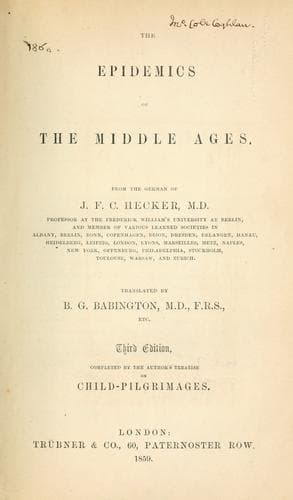
The Epidemics of the Middle AgesHecker, J. F. C. (Justus Friedrich Carl)
History
The Epidemics of the Middle Ages
Hecker, J. F. C. (Justus Friedrich Carl)
Black Death; Epidemics -- History; Hysteria, Epidemic
Before we proceed further, some account is here required of the
nature of this disease. It was an inflammatory rheumatic fever, with
great disorder of the nervous system. This assumption is supported
by the manner of its origin and its especial characteristic of being
accompanied by a profuse and injurious perspiration. From the judgment
that we are now capable of forming of the pernicious influences which
prevailed in the year 1485, it may, without hesitation, be admitted
that the humidity of that and of the preceding years affected the
functions of the lungs and of the skin, and disturbed the relation
of this very important tissue to the internal organs of life. This
is the usual commencement of rheumatic fevers, which bear the same
relation to the Sweating Sickness as slight symptoms bear to severe
ones of the same kind. The predominance of affections of the brain
and of the nerves, however, gave to the English epidemic a peculiar
character. The functions of the eighth pair of nerves were violently
disordered in this disease, as was shewn by oppressed respiration and
extreme anxiety with nausea and vomiting, symptoms to which the moderns
attach much importance[398]. The stupor and profound lethargy shew
that there was injury of the brain, to which, in all probability, was
added a stagnation of black blood in the torpid veins. We must also
take into the account a previous corruption and decomposition of the
blood, which, even if we should be disinclined to infer their existence
from the offensive perspiration of the disease itself, were proved
by striking phenomena of a similar nature that occurred in Central
Europe about the same time; for the scurvy prevailed as an epidemic,
more especially in Germany, in the year 1486, and with such severe
and unusual symptoms, that people were inclined to regard it as a
totally new malady[399]. Now such is the vital connexion of different
functions that every impediment to respiration, whether in consequence
of pressure from without, or through spasm and irritation of the nerves
from within, or even from a morbid condition of the circulating fluid,
infallibly calls forth the compensating activity of the skin, and the
body becomes suffused with an alleviating perspiration.
Public-domain text, read in full here on John Shaqi.
Reviews
Reviews
No reviews yet
Be the first to share your thoughts on this work.
Elsewhere in the archive
Join the Discussion
Join the discussion
Sign in to leave a comment or review.
Sign InorCreate an account