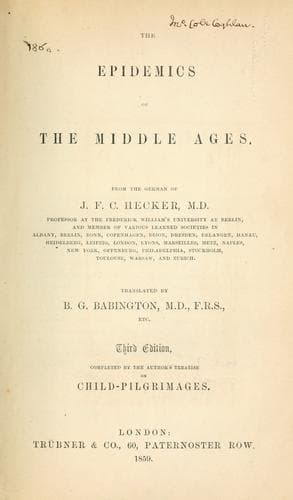
The Epidemics of the Middle AgesHecker, J. F. C. (Justus Friedrich Carl)
History
The Epidemics of the Middle Ages
Hecker, J. F. C. (Justus Friedrich Carl)
Black Death; Epidemics -- History; Hysteria, Epidemic
Thus it plainly appears that the profuse perspiration in the disease
of which we are treating, notwithstanding its apparently injurious
tendency, was the result of a commotion excited on the part of the
lungs, which was critical with respect to the disease itself; and
this is in accordance with all the causes of which we still have any
knowledge. Noxious and even stinking fogs penetrated into the organs
of respiration, and as the blood was thus so much affected in its
composition and in its vitality that its corrupt state was only to
be obviated by profuse perspiration, the inevitable consequence was
an interference with the extensive functions of the eighth pair of
nerves, which interference, as later writers relate, extended in many
cases to the spinal marrow, and brought on violent convulsions[400].
We have here only one essential cause, out of many, for this gigantic
disease, and one too which accounts for its advance and spread. It
is highly probable, for the reasons stated, and as according with
all human experience, that it first broke out in the army of Henry
the VIIth, and beyond all doubt that it spread from west to east,
and afterwards in a retrograde course from east to west. With the
perfectly equable operation of the predisposing causes, from which
the disease ought indubitably to have broken out all over England
at the same time, had the condition of the atmosphere been its sole
occasion, we must additionally presume a special cause for its progress
through towns and villages. This, according to all appearance, was to
be found in the air, impregnated with foul odours, which surrounded
the sick, and abounded in the tents and dwellings in which Henry the
VIIth’s soldiers, after various privations and hard service, amid
storms and rain, were closely crowded together. Of both causes modern
observation furnishes analogous examples. Intermittent fevers spread
more easily in air which is contaminated by sick people, and bands
of soldiers, themselves in perfect health, have not unfrequently
conveyed camp fever to remote places. It signifies very little by
what expressions of the schools these occurrences are designated; it
is best perhaps to abstain from them altogether, for they are all
inadequate, and occasion misconceptions. Contemporaries, however,
were certainly justified in not admitting the notion of contagion in
the same sense as when the term is applied to the plague, with which
they were well acquainted[401]. For very frequently cases which were
not to be explained on the principle of contagion communicated by
persons diseased, occurred among people of rank, and manifestly arose
independently of the usual causes. In these cases the fear of death,
which everywhere was the harbinger of the disease, and threw the nerves
of the chest into spasmodic commotion, gave an impulse to the malady
for which the quality of the atmosphere and luxury had long made
preparation. Had this view of contemporaries been even less impartial
Public-domain text, read in full here on John Shaqi.
Reviews
Reviews
No reviews yet
Be the first to share your thoughts on this work.
Elsewhere in the archive
Join the Discussion
Join the discussion
Sign in to leave a comment or review.
Sign InorCreate an account