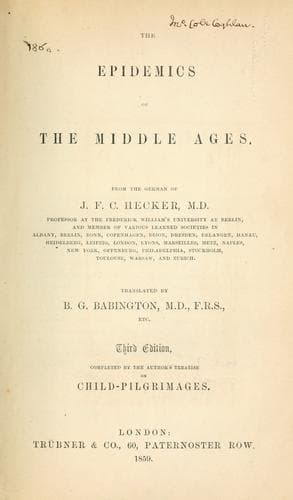
The Epidemics of the Middle AgesHecker, J. F. C. (Justus Friedrich Carl)
History
The Epidemics of the Middle Ages
Hecker, J. F. C. (Justus Friedrich Carl)
Black Death; Epidemics -- History; Hysteria, Epidemic
About the same period, in October, 1505, a very fatal disease broke out
in Lisbon, the further progress of which was marked by the terror, the
flight, and the confusion of the inhabitants[422]. Of what kind it was,
whether a petechial fever or a bubo plague, and what connexion it had
with a pestilence in Spain which had just preceded it, it would perhaps
be difficult now to ascertain. This latter pestilence had spread from
Seville, following an earthquake, and violent storms of wind and rain
in 1504, and may very likely have been a bubo plague. Similar notices
are met with of pestilences occurring in that country in 1506, the
year of the English Sweating Sickness, in 1507 and 1508, in which
years mention is made of swarms of locusts in the neighbourhood of
Seville, and finally in 1510, the year of a great influenza[423], and
1515. Exact descriptions, however, of these disorders are entirely
wanting[424].
With all the above phenomena, the epidemics which took place in
Germany and France at the commencement of the sixteenth century,
evidently unite to form a connected whole. Varying in intensity and
extent, they continued without intermission for full five years, and
moreover were accompanied by unusual circumstances, such as occur only
in the time of great pestilences. The century was ushered in by the
appearance of a comet[425], which, on this occasion, seemed to confirm
the long cherished belief that the appearance of these heavenly bodies
was prognostic of evil. For mankind are in the habit of concluding that
phenomena which are simultaneous must have some internal connexion, and
many examples were called to mind in which great pestilences affecting
the whole world had been either preceded or accompanied by comets[426].
Immediately afterwards a great murrain among cattle took place,
which may have proceeded from some injurious quality in their food.
A notion immediately arose that the pastures were poisoned, and of
this there was so firm a conviction, that the most violent resentment,
as of old, in the time of the Black Death, prevailed against the
supposed poisoners, and in the neighbourhood of Meissen some “böse
Buben” (wicked knaves) who had fallen under suspicion, were actually
executed[427].
Public-domain text, read in full here on John Shaqi.
Reviews
Reviews
No reviews yet
Be the first to share your thoughts on this work.
Elsewhere in the archive
Join the Discussion
Join the discussion
Sign in to leave a comment or review.
Sign InorCreate an account